
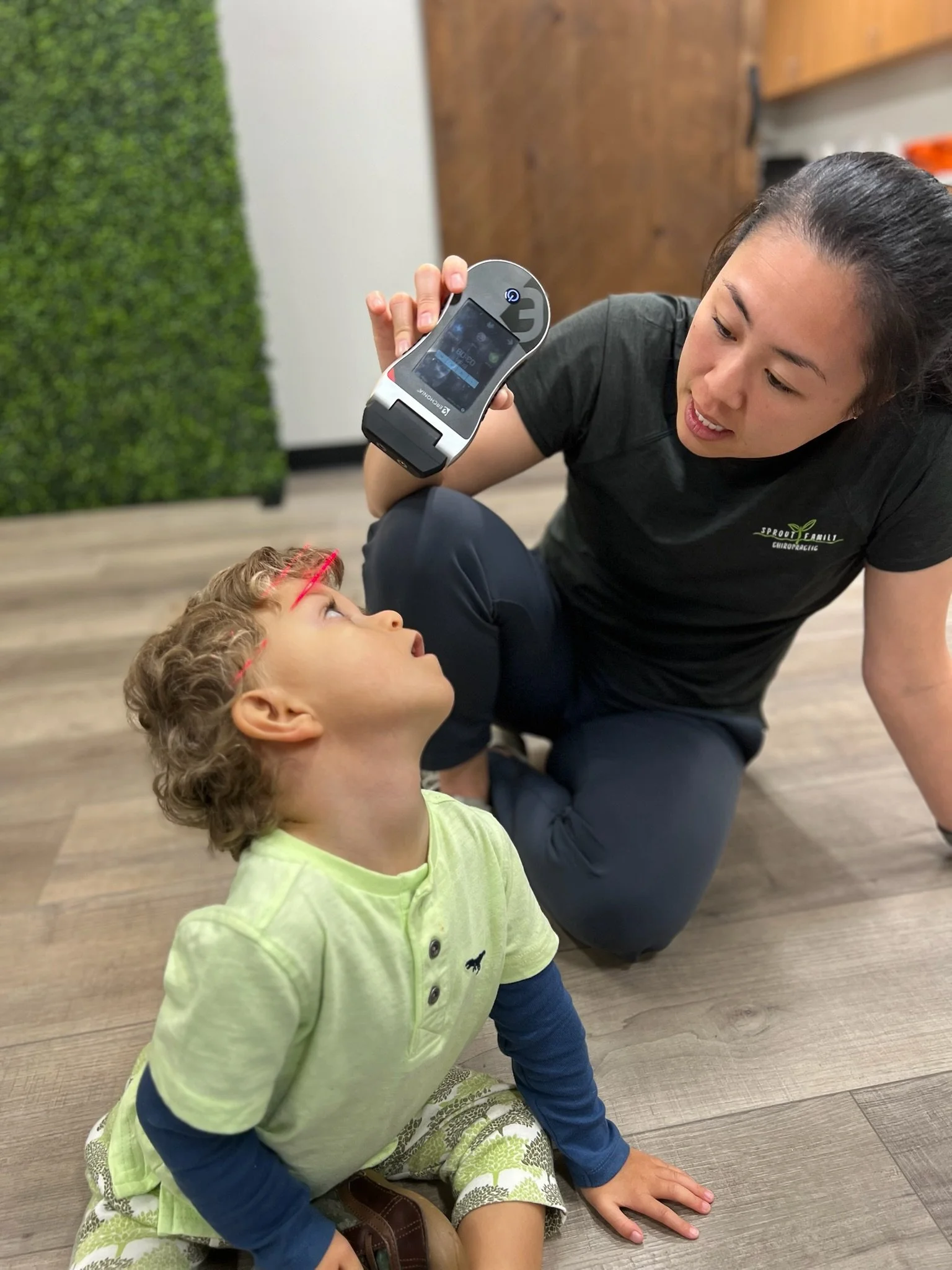
Maybe you first heard the word in a functional medicine appointment. Or you came across it late at night, scrolling through research after your child went to bed. Mitochondria. Cellular energy. Lab results with words like "lactate" circled in red.
If you're the kind of parent who reads the studies, this post is for you. We'll explain what mitochondria are, what the research says about them in autism, and how low-level laser therapy fits in, including what the research does and doesn't show yet.
The short answer
Mitochondria are the energy factories inside every cell, and the brain is one of the body's most energy-hungry organs. Research has found signs of mitochondrial differences in a meaningful share of autistic children. Low-level laser therapy uses specific wavelengths of light that are thought to help mitochondria make energy more efficiently. Early research in autism is promising but still limited, and we see laser as one part of a broader, nervous-system-focused plan.
What mitochondria do
Almost every cell in your child's body contains mitochondria. Their main job is to turn the food we eat and the oxygen we breathe into ATP, the energy that powers everything cells do.
Some parts of the body need more energy than others. The brain, the gut, and the muscles are among the hungriest. When energy production isn't running smoothly, those are often the systems that struggle first. That's one reason parents sometimes see challenges cluster together: focus, sleep, digestion, low muscle tone, and how quickly a child tires out.
What research shows in autism
The most cited summary of this research is a 2012 systematic review and meta-analysis by Rossignol and Frye in Molecular Psychiatry. It found:
• About 5% of autistic children met criteria for mitochondrial disease, far higher than the roughly 0.01% seen in the general population.
• About 31% showed elevated lactate, a common lab marker that can signal strained energy production.
The authors concluded that mitochondrial dysfunction is associated with autism, while noting that more research is needed. In other words: most autistic kids don't have mitochondrial disease, but a meaningful number may have cells that are working harder than they should to make energy.
If you're concerned about mitochondrial disease specifically, that's a question for your child's pediatrician or a specialist, who can order the right testing.
How low-level laser therapy works
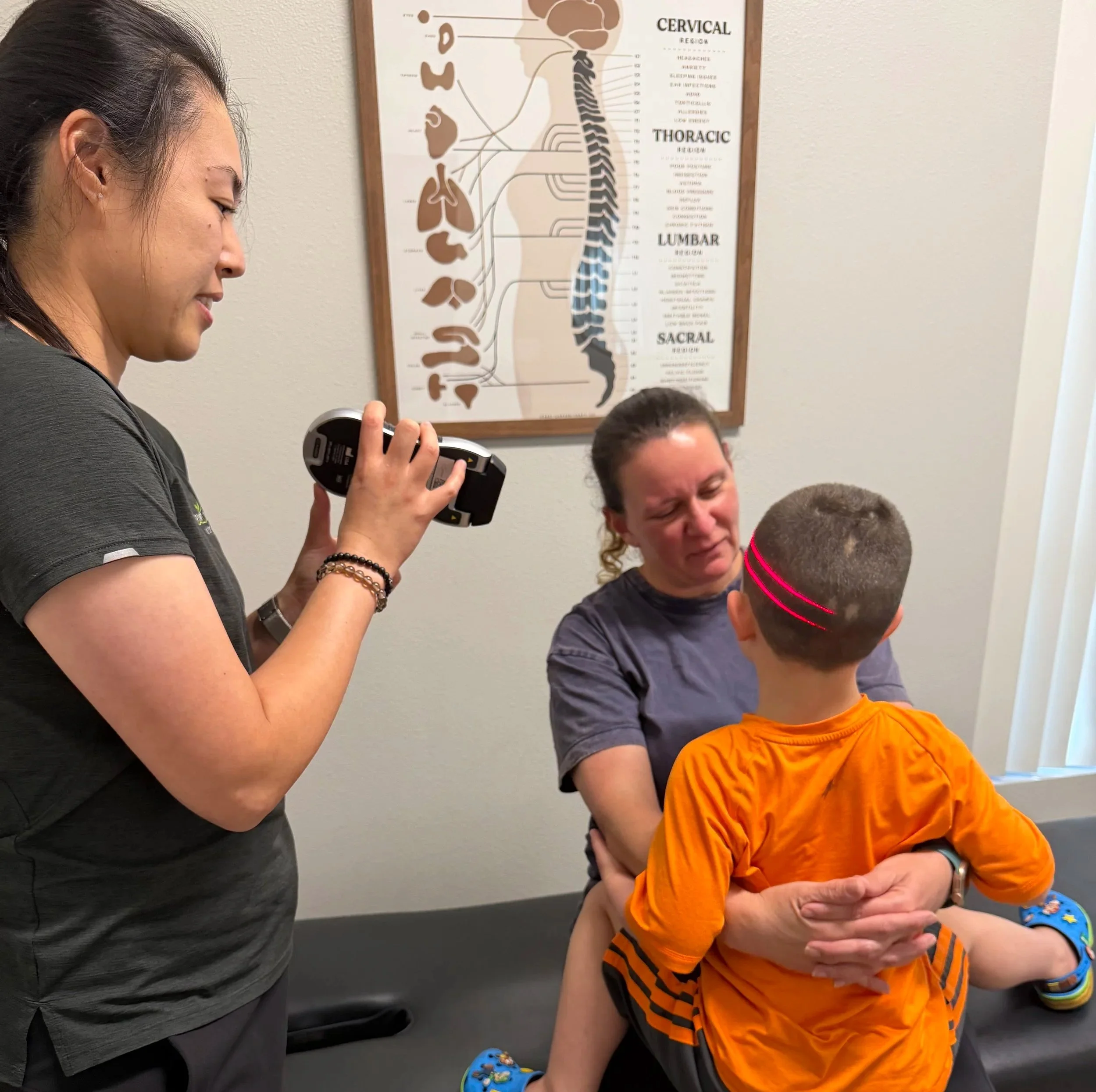
Gentle laser therapy for kids with autism in San Diego
Low-level laser therapy (LLLT), also called photobiomodulation, uses specialized gentle red light. It's "low-level" because it doesn't heat or cut tissue the way surgical lasers do.
The leading explanation for how it works centers on the mitochondria. Researchers de Freitas and Hamblin describe how an enzyme in the mitochondria's energy-making chain, cytochrome c oxidase, absorbs this light. The light appears to free up the enzyme so it can use oxygen more efficiently, which supports ATP production.
In plain terms: the right wavelengths of light may help cells make energy more easily. That's why LLLT has been studied for everything from wound healing to recovery after injury.
What the autism research says (and doesn't say yet)
You deserve an honest picture, so here it is.
The encouraging part. In a 2018 placebo-controlled study by Leisman and colleagues, 40 autistic children and teens ages 5 to 17 received either low-level laser therapy or a placebo. The laser was applied to the base of the skull and the sides of the head in eight 5-minute sessions over four weeks. The laser group showed significantly greater reductions in irritability, and the improvements held, and even grew, at follow-up four weeks later.
The limits. That's one study, with a modest number of children, focused mainly on irritability. Larger studies are needed to know how well LLLT works, which children benefit most, and how long effects last. Research hasn't shown that laser therapy improves every challenge associated with autism, and it isn't a cure.
Where that leaves us. LLLT is gentle, painless, and has a strong scientific rationale. Early results in autism are encouraging. We use it as one part of a broader, nervous-system-focused plan, not as a stand-alone treatment, and we're always clear with families about what the evidence does and doesn't show.
How we use laser therapy at Sprout Family Chiropractic
We do not treat or cure autism. We focus on the nervous system and the everyday challenges that make life harder for your child, and laser therapy is one of the tools we use.
We use the Erchonia XLR8 and GVL. These Class 2 lasers produce no heat or thermal effect, so they're comfortable even for kids who are very sensitive to touch and sensation.
We pair it with chiropractic care. Laser therapy supports the body at the cellular level. Gentle chiropractic care, using Sacro-Occipital Technique (SOT), cranial work, and gentle instrument-assisted adjustments, supports communication between the brain and body. We think of them as working hand in hand.
We decide together if it's a fit. Not every child needs laser therapy. After your child's Initial Visit, including INSiGHT nervous system scans, we'll explain whether we recommend it and why.
What a laser session looks like
• It's painless. Most kids feel nothing at all. Some describe a gentle warmth or tingle.
• Kids play through it. Your child doesn't need to lie still. Most kids keep playing, sitting on your lap, or watching a toy the whole time.
• It's quick. Sessions take about 5 to 10 minutes and fit into your child's regular visit.
• It's gentle on sensory kids. There's no sound, no pressure, and nothing your child needs to tolerate on their skin for long.
What a typical care plan looks like
The nervous system changes through repetition, not one visit. Our typical plan for autistic kids starts with 3 months of care, 3 visits per week, with progress exams every 12 visits. We tailor every plan, including whether and how often laser is used, to the child.
One family's story
One family's son had a hard time with attention and focus, especially with schoolwork. After adding laser therapy to his care, his parents noticed his attention and focus were much better on days he had laser.
He could do seated tasks for longer stretches. His parents also noticed sharper thinking, an easier time juggling more than one thing, and schoolwork getting done faster. They told us laser was where they saw the most change.
Every child is different, and results vary. We share stories like this with families' permission to show what progress can look like.
Frequently asked questions
Is low-level laser therapy safe for children? The lasers we use produce no heat and are painless. Most kids feel nothing and play right through their session.
Is this the same as red light panels sold online? Not exactly. Home red light products vary widely in wavelength, power, and how they deliver light. Clinical low-level lasers are designed to deliver specific wavelengths in a targeted way. If you're using a home device, tell us so we can factor it in.
Is laser therapy a treatment for autism? No. We don't treat or cure autism. We use laser therapy to support cellular energy, the nervous system, and the body's natural healing, as one part of a broader care plan.
Can laser therapy replace my child's other therapies? No. It works best alongside chiropractic care and the therapies your child already has, like OT, speech, and ABA.
Does my child need laser therapy? Not necessarily. We'll recommend it only if we think it's a good fit, and we'll explain why.
Your next step
If you've been reading the research and wondering whether laser therapy could support your child, we'd love to talk it through with you.
Your Initial Visit happens in two parts:
1. Visit 1: a conversation about your child's history, a gentle chiropractic exam, and INSiGHT nervous system scans
2. Visit 2: we walk you through what we found and recommend a care plan, including whether laser therapy is a good fit, so you can decide what's right for your family
We're located at 8799 Balboa Ave in Kearny Mesa, San Diego. We accept HSA and FSA cards. Have questions first? Call us at (619) 786-4886.
Read More Articles Like This
Can Light Therapy Help Kids with Autism?
Doing ABA, OT, and Speech but Progress Has Stalled? The Missing Piece Many Parents Overlook
Sources
Proudly supporting kids with Autism across Clairemont, Mira Mesa, Scripps Ranch, Kearny Mesa, La Jolla, and all of San Diego
Sprout Family Chiropractic | Pediatric + Nervous System Experts
Disclaimer: This article is for educational purposes and is not intended as medical advice. Always consult your child’s healthcare provider for personalized guidance.