
You've done everything right. You got the diagnosis early. You fought for the services. You drive to ABA, OT, and speech every week, practice the strategies at home, and track the goals. For a while, the progress felt real.
Then it slowed. The same goals roll over from one report to the next. The therapist says your child "has the skill but can't use it consistently." Some weeks your child seems to go backward, and you can't figure out why.
If you're feeling stuck, discouraged, or quietly wondering whether you're missing something, you're not alone. A therapy plateau is one of the most common reasons families find their way to us.
The short answer
Learning needs a nervous system that feels safe enough to learn. When a child's body is stuck in fight-or-flight, the parts of the brain that handle attention, memory, and flexible thinking don't work at full strength, so new skills are hard to learn and even harder to use. Therapy teaches the skills. Supporting the nervous system can help create the conditions where those skills finally stick.
Why progress plateaus: stress and the learning brain
The prefrontal cortex, the front part of the brain, handles focus, working memory, and thoughtful responses. It's also the part most sensitive to stress.
Research from Amy Arnsten's lab at Yale shows that stress quickly weakens prefrontal function. Under stress, the brain shifts control to faster, more reflexive circuits that drive emotional reactions and habits. That shift helps in an emergency. But it gets in the way when the task requires calm, deliberate thinking, which is exactly what therapy asks of a child.
Now picture a child whose nervous system spends much of the day on high alert. In a session, they're being asked to sit, attend, imitate, take turns, and try something hard. Their brain is working against itself. The skill may be in there, but the stress response keeps pulling the brain back toward survival mode.
That's why so many parents hear "they can do it, just not consistently." Consistency depends on state. On a calm day, the skill shows up. On a dysregulated day, it disappears.
Other things that quietly block progress
• Poor sleep. A tired brain struggles to store what it learned during the day.
• Gut discomfort. Constipation and tummy pain pull attention away from learning. (See Why Is My Autistic Child Always Constipated?)
• Sensory overload. A child who's working hard to cope with lights, sounds, and textures has less left for the task.
• The end-of-day crash. By late-afternoon therapy, many kids have been holding it together for hours.
Signs the nervous system may be the missing piece

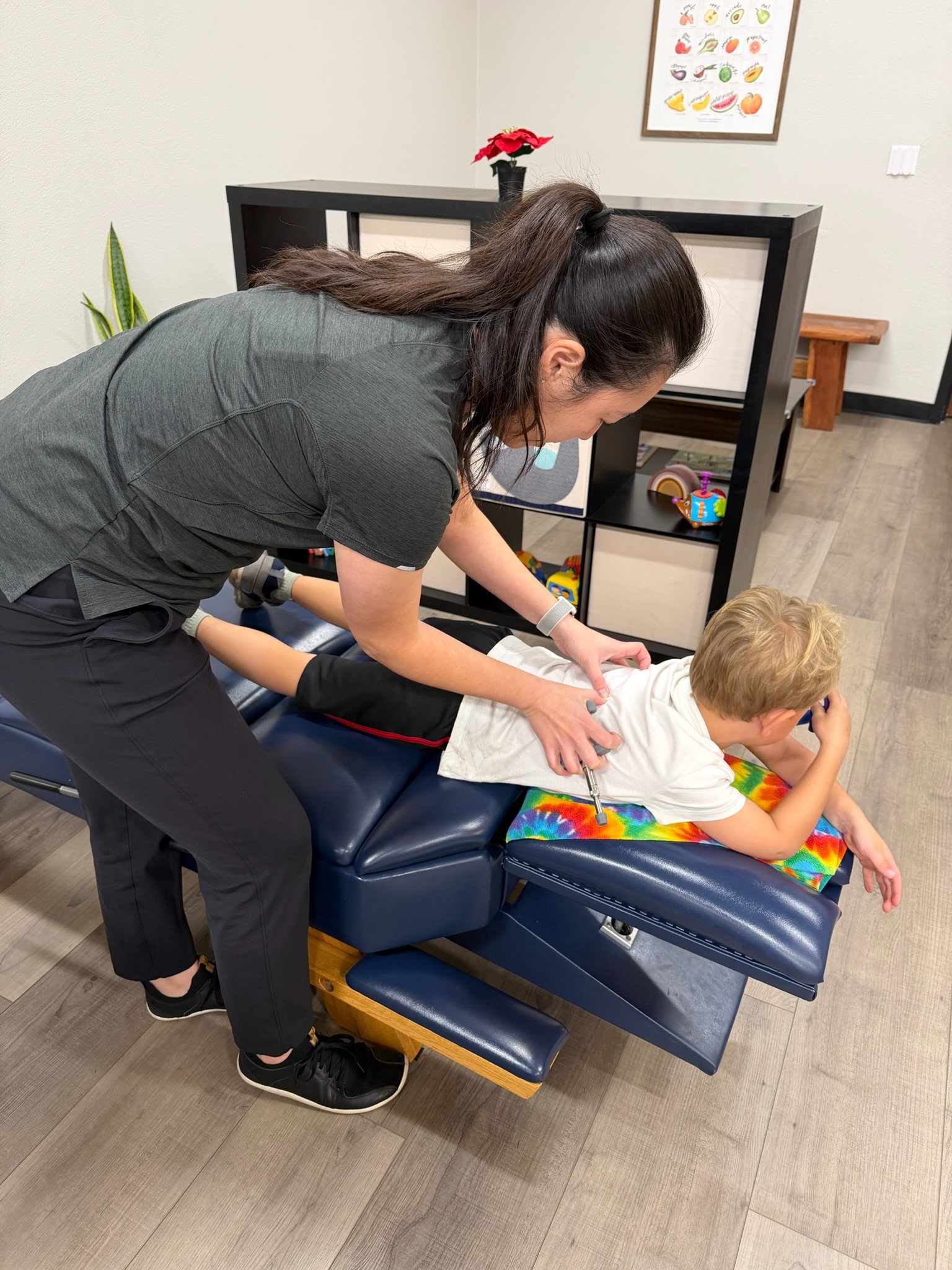
Sprout Family Chiropractic in San Diego, gentle care for kids with autism
Not every plateau has the same cause. But these patterns often point to a nervous system that isn't feeling safe enough to learn:
• Skills come and go. Your child can do it on Monday and can't on Thursday.
• Good days follow good nights. Progress tracks closely with how your child slept or how their belly feels.
• Big swings in a single session. A strong start, then a sudden shutdown or meltdown.
• Skills stay in the therapy room. Your child does well one-on-one but can't use the skill at home, at school, or in a group.
• Getting to therapy is the hardest part. Transitions in and out of sessions are a battle.
• Setbacks with every change. Illness, a new teacher, or a schedule change sends progress backward for weeks.
If several of these sound familiar, your child's therapy may be working fine. It may just be working against a body stuck on high alert.
How to talk with your child's therapy team
Your therapists are your partners, and they've likely noticed these patterns too. A few questions can open a helpful conversation:
1. When does my child do their best work? Time of day, after certain activities, on certain days?
2. What do you see on hard days? Is it a skill gap or a regulation gap?
3. Are there regulation goals in my child's plan? OTs in particular often address this directly.
4. What would help my child come in more ready to learn? Sleep, snacks, movement, a calmer drive?
How we help therapy progress stick at Sprout Family Chiropractic
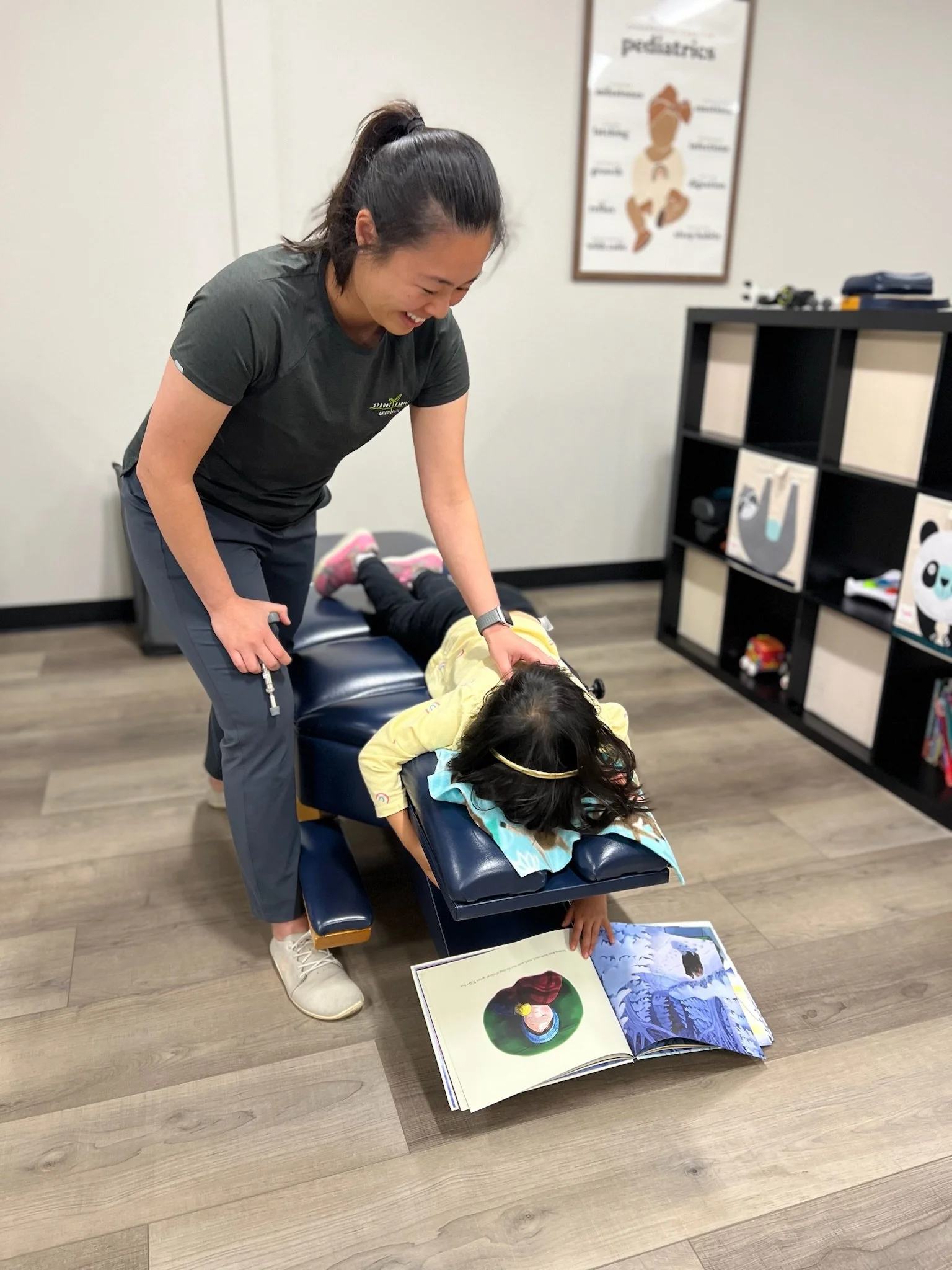
Gentle pediatric chiropractic adjustment for kids with autism in San Diego
We do not treat or cure autism, and we never replace your child's therapies. Our role is to support the nervous system underneath them, so your child comes to therapy more ready to learn.
1. We look at the foundation. INSiGHT scans at your child's first visit show how their nervous system is handling stress. That helps us see whether a stress pattern may be getting in the way.
2. We use gentle, kid-specific techniques. We're trained through the ICPA and PX Docs and use Sacro-Occipital Technique (SOT), cranial work, and gentle instrument-assisted adjustments. Light touch, no cracking, and always at your child's pace.
3. We add low-level laser therapy when it fits. We use the Erchonia XLR8 and GVL lasers to support mitochondrial health and the body's natural healing. Learning is hard work for the brain, and these lasers support cellular energy. No heat; most kids play right through it.
4. We're on your child's team. We encourage families to keep going with ABA, OT, speech, and PT. We often hear from parents that their child's therapists notice changes too.
What a typical care plan looks like
The nervous system changes through repetition, not one visit. Our typical plan for autistic kids starts with 3 months of care, 3 visits per week, with progress exams every 12 visits. We tailor every plan to the child.
One family's story
One family had been doing speech therapy with their autistic son for a year and a half when progress stalled. They'd hit a plateau, and nothing seemed to move it.
After adding laser therapy to his care with us, they noticed he was saying more words. Before long, he was stringing several words together.
His speech therapy didn't stop. It finally had something to build on.
Every child is different, and results vary. We share stories like this with families' permission to show what progress can look like.
Frequently asked questions
Should we stop or cut back on therapy if we start chiropractic care? No. We see our care as support for your child's therapies, not a replacement. Many families find their child gets more out of the therapies they're already doing.
How is this different from what OT does for regulation? OT teaches your child skills and strategies for regulation, which is valuable. We focus on the nervous system itself, through gentle adjustments and laser therapy. The two work well together.
Will my child's therapists know about chiropractic care? That's up to you. Many parents share what they're doing, and therapists are often the first to notice changes in focus, engagement, or regulation.
Is this safe alongside medications? Yes. We work alongside your child's medical care and never ask families to stop or change a medication.
How do I know if a plateau is a nervous system issue? You may not know for sure on your own, and that's what the Initial Visit is for. We'll listen to your child's history, do a gentle exam and INSiGHT scans, and tell you honestly what we see.
Your next step
If you've been doing all the right things and progress still feels stuck, it may be time to look at the foundation.
Your Initial Visit happens in two parts:
1. Visit 1: a conversation about your child's history, a gentle chiropractic exam, and INSiGHT nervous system scans
2. Visit 2: we walk you through what we found and recommend a care plan, so you can decide what's right for your family
We're located at 8799 Balboa Ave in Kearny Mesa, San Diego. We accept HSA and FSA cards. Have questions first? Call us at (619) 786-4886.
Read More Articles Like This
Autism and ADHD Together: Why Focus Is So Hard (and What Helps)
Is My Child Stuck in Fight-or-Flight? 12 Signs in Autistic Kids
Can Light Therapy Help Kids with Autism?
Sources
• Arnsten Lab, Yale School of Medicine: how stress impairs prefrontal cortex function (see also Arnsten AF. Stress signalling pathways that impair prefrontal cortex structure and function. Nat Rev Neurosci. 2009)
Proudly supporting kids with Autism across Clairemont, Mira Mesa, Scripps Ranch, Kearny Mesa, La Jolla, and all of San Diego
Sprout Family Chiropractic | Pediatric + Nervous System Experts
Disclaimer: This article is for educational purposes and is not intended as medical advice. Always consult your child’s healthcare provider for personalized guidance.