

Dinner is ready. You've set a place for everyone. Your partner and siblings sit down. And your child is in their room, on the couch, or in the hallway with the same three foods they've eaten for months, as far from the table as they can get.
You've tried the sticker charts, the "one bite" rule, and the special plate. Some nights you just let it go, because a child who eats alone is better than a child who doesn't eat at all. But part of you still pictures a family dinner where everyone is together.
If that's your house, please know you're not doing anything wrong, and you're far from alone.
The short answer
For many autistic kids, the table is one of the most demanding places in the house. Smells, textures, sounds, sitting still, eye contact, and conversation all hit at once, often in a body that's already uncomfortable from constipation or stuck in fight-or-flight. Eating alone or refusing the table is usually a way to cope, not defiance. Lowering the sensory load, supporting the gut, and helping the nervous system feel safer can all make shared meals more possible over time.
How common are feeding challenges in autism?
Very common. A 2013 meta-analysis led by William Sharp at Emory University found autistic children were about five times more likely than their peers to have a feeding problem. Those problems included severe mealtime tantrums, very limited food choices, and ritualistic mealtime behaviors. The researchers also found lower intake of calcium and protein, and recommended routine screening for feeding concerns.
So if mealtimes in your house look different from the picture you imagined, you're in very good company.
Why the table is so hard
Sensory overload, all at once
Think about everything a family dinner asks of a child's senses: the smell of several foods at once, the clink of forks, overlapping voices, bright kitchen lights, a chair that feels wrong, and food textures touching on the plate. For a child whose senses are turned up, that's a lot to process before the first bite.
Eating alone in a quiet room with familiar foods removes most of that. It makes sense that so many kids choose it.
A belly that doesn't feel good
Constipation is very common in autistic kids, and a full, uncomfortable belly kills appetite. It can also make a child gag more easily or avoid new foods. Many kids can't tell you their tummy hurts; they just refuse to eat or walk away. (We dive into this in Why Is My Autistic Child Always Constipated?)
A nervous system on alert
When the body is in fight-or-flight, digestion slows and appetite drops. That's the body's design: it puts eating on hold while it deals with a perceived threat. A child who's been on high alert all day may arrive at dinner with no appetite and no patience for anything new. Familiar "safe foods" feel predictable, and predictability feels safe. (More in Is My Child Stuck in Fight-or-Flight?)
The social demands of the table
Family meals come with unspoken expectations: sit still, face people, make eye contact, take turns talking, try what's served. For many autistic kids, each of those is work. Put them all together, and the table can feel like a performance rather than a meal.
Muted body signals
Some autistic kids don't clearly feel hunger or fullness. They may not realize they're hungry until they're already dysregulated, or may graze rather than sit for a meal.
Small steps that help at home
These ideas lower pressure and make shared meals feel safer. Your child's feeding therapist can help tailor them.
• Start where your child is. If they eat in the living room, sit with them there sometimes. Being together matters more than where.
• Turn the sensory volume down. Softer lighting, no TV, a quieter room, or headphones at the table if they help.
• Always include a safe food. Put at least one food your child reliably eats on the table at every meal, with no strings attached.
• Drop the pressure. "One bite" rules and praise for eating can backfire for anxious eaters. Let new foods simply be nearby.
• Keep table time short. Five calm minutes beats thirty stressful ones. Build from there.
• Move first. Jumping, swinging, or a walk before dinner can help some kids settle into their bodies before sitting down.
• Celebrate small wins. Sitting near the table, touching a new food, or eating in the same room as the family are real progress.
One mom in our practice shared that her nonverbal daughter, who had always wanted to eat alone in bed, started bringing her favorite foods into the living room to eat with the family. Her next goal was the table. That may sound small to someone else, but for that family, it was huge.
When to get a feeding evaluation
Talk to your pediatrician, and ask about a feeding team (often an OT or speech therapist who specializes in feeding, plus a dietitian), if your child:
• Is losing weight or not growing as expected
• Eats a list of foods that keeps getting shorter
• Gags, chokes, or vomits often during meals
• Has dropped entire food groups
• Becomes extremely distressed at mealtimes
• Shows signs of low energy or nutritional deficiency
Picky eating and a serious feeding disorder can look similar from the outside. A professional evaluation helps you know which one you're dealing with.
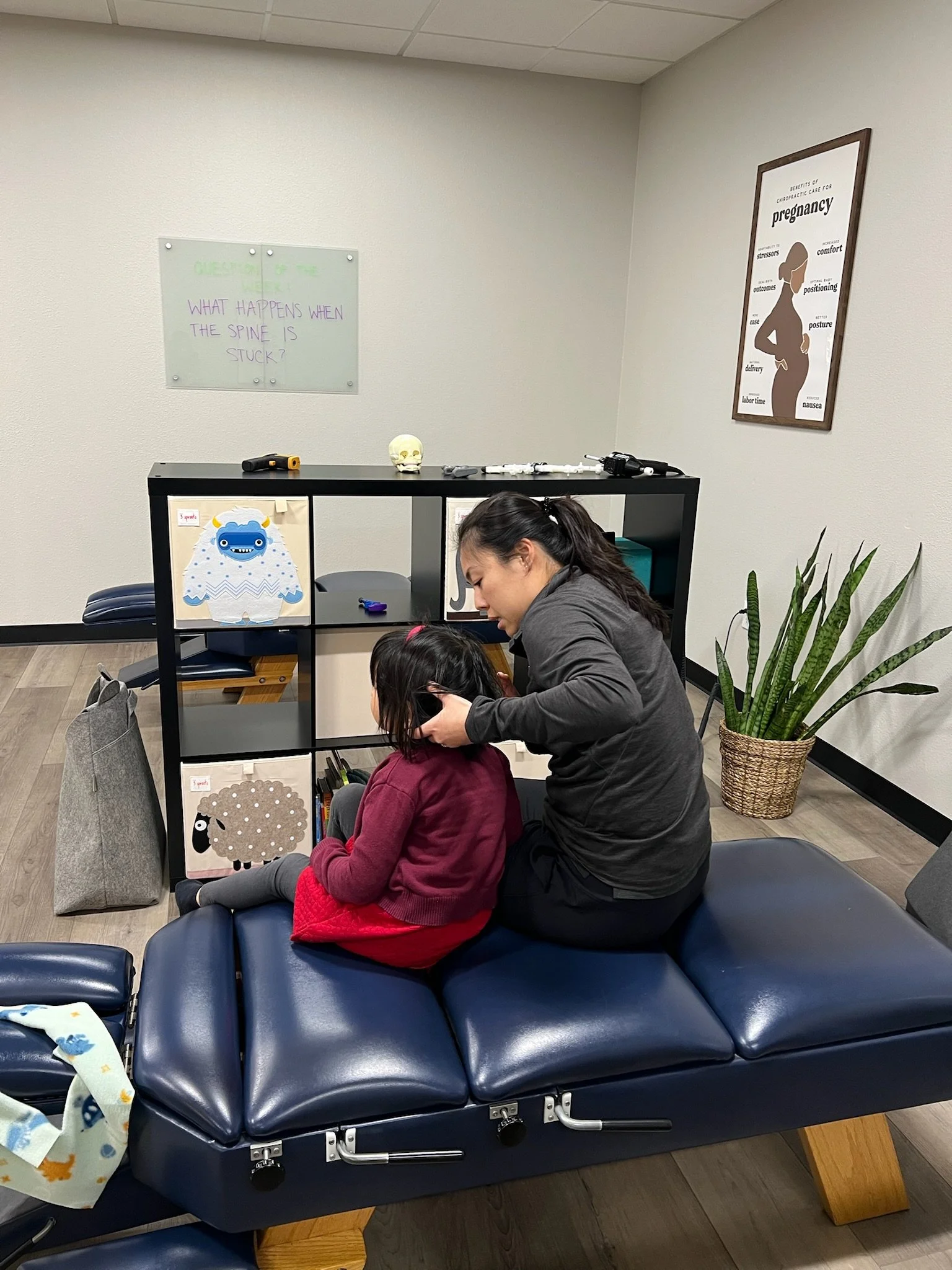
Gentle pediatric chiropractic for kids with autism in San Diego
How we support mealtimes at Sprout Family Chiropractic
We don't treat feeding disorders, and we don't replace a feeding team. We focus on the nervous system and the body-level challenges that make the table harder.
We look at the whole picture. At the first visit, INSiGHT scans show how your child's nervous system is handling stress. We'll also ask about digestion, sleep, and sensory patterns, because they often travel together.
We support a calmer nervous system. Sacro-Occipital Technique (SOT), cranial work, and gentle instrument-assisted adjustments, with no cracking and always at your child's pace. A body that feels safer is often more open to new experiences, including new foods and new places to eat.
We pay attention to the gut. Many of the families we see come in for both regulation and constipation. Many notice that as their child's belly feels better, appetite and mood improve too.
We add low-level laser therapy when it fits, using the Erchonia XLR8 and GVL lasers to support mitochondrial health and the body's natural healing.
What a typical care plan looks like
The nervous system changes through repetition, not one visit. Our typical plan for autistic kids starts with 3 months of care, 3 visits per week, with progress exams every 12 visits. We tailor every plan to the child.
Frequently asked questions
Is it okay to let my child eat away from the table? For many families, yes, at least for now. Eating comfortably somewhere is better than not eating. You can work toward the table in small steps, with guidance from a feeding therapist.
Can chiropractic care help my child eat more foods? We don't treat feeding disorders. We focus on the nervous system and gut comfort, which often play a role. Many families notice mealtimes get easier as their child feels calmer and their belly feels better, but every child is different.
Should I stop feeding therapy if we start care? No. We support your child's feeding team, never replace it.
Could constipation be making my child's eating worse? It's possible. A full, uncomfortable belly can reduce appetite and make kids more sensitive to new foods. Talk with your pediatrician, and see our post on constipation for more.
My child only eats a handful of foods. Should I worry? If the list is stable and your child is growing well, it may be manageable. If it's shrinking, or your child isn't growing, talk to your pediatrician about a feeding evaluation.
Your next step
If mealtimes in your house feel like a daily battle, we'd love to help you look at what's happening underneath.
Your Initial Visit happens in two parts:
1. Visit 1: a conversation about your child's history, a gentle chiropractic exam, and INSiGHT nervous system scans
2. Visit 2: we walk you through what we found and recommend a care plan, so you can decide what's right for your family
We're located at 8799 Balboa Ave in Kearny Mesa, San Diego. We accept HSA and FSA cards. Have questions first? Call us at (619) 786-4886.
Read More Articles Like This
Why Is My Autistic Child Always Constipated? A Nervous System Guide for San Diego Parents
Sensory Seeking in Autistic Kids: Why They Crash, Spin, and Never Stop Moving
Is My Child Stuck in Fight-or-Flight? 12 Signs in Autistic Kids
The Gut–Brain–Immune Connection in Kids
Sources
Proudly supporting kids with Autism across Clairemont, Mira Mesa, Scripps Ranch, Kearny Mesa, La Jolla, and all of San Diego
Sprout Family Chiropractic | Pediatric + Nervous System Experts
Disclaimer: This article is for educational purposes and is not intended as medical advice. Always consult your child’s healthcare provider for personalized guidance.