
The couch cushions are on the floor again. Your child has launched off the arm of the sofa for the fifteenth time, spun in circles until you got dizzy watching, and is now chewing the collar of their shirt. You've replaced the shirt, bought the chew necklace, and moved the coffee table out of the way. They still crash into you, the walls, the dog.
People say "they're just a busy kid." But you know it's more than that. It's like your child's body is starving for something, and nothing fills it up.
When parents tell us "my child is sensory seeking," this is usually what they mean. And they're right that something deeper is going on.
The short answer
Sensory seeking is a child's way of getting input their nervous system isn't registering well enough on its own. Many autistic kids are under-responsive to certain kinds of input, especially from their own muscles, joints, and balance system, so they move, crash, spin, and chew to feel their body and get regulated. It isn't bad behavior. It's the nervous system asking for help, and supporting how the nervous system processes input can make that need less intense.
What sensory seeking looks like
You might see:
• Crashing, jumping, and throwing themselves onto furniture or people
• Spinning, swinging, or hanging upside down without getting dizzy
• Chewing shirts, toys, or anything within reach
• Squeezing, hugging hard, or seeking tight spaces
• Touching everything, rubbing textures, or seeking strong smells and tastes
• Making noise or seeking loud sounds
• Constant motion, even when they're tired
How common is it?
Sensory differences are so common in autism that they're part of the diagnostic criteria. A meta-analysis of 14 studies (Ben-Sasson et al., 2009) found autistic children showed far more sensory symptoms than other children. The biggest difference was in under-responsivity, meaning not registering input as strongly, followed by over-responsivity, then sensation seeking. The differences were largest in children ages 6 to 9.
That ordering matters. Under-responsivity and seeking often go together: when a child doesn't feel input strongly, they go looking for more of it.
The hidden senses behind sensory seeking
Most of us learned about five senses. But three "hidden" senses drive most sensory seeking:
• Proprioception tells your brain where your body is and how hard your muscles are working. It comes from sensors in the muscles, joints, and spine. Crashing, squeezing, jumping, and chewing all deliver big doses of it.
• Vestibular input comes from the inner ear and tells the brain about balance, movement, and which way is up. Spinning, swinging, and hanging upside down feed it.
• Interoception is the sense of what's happening inside the body, like hunger, a full bladder, or a tummy ache. When it's muted, a child may not notice discomfort until it boils over.
When these signals come through faintly, the child's body doesn't feel "organized." Crashing into the couch isn't random; it's the fastest way to get a strong, clear signal that says "here's my body, here's where I am."
The nervous system dial, again
In our post on autism, ADHD, and focus, we described the nervous system as a dial. Attention and calm work best in a middle zone.
Sensory seeking often happens when a child's system sits at the low end of the dial: under-aroused, foggy, not registering their body well. Movement and pressure turn the dial up. That's why your child might be calmer and more focused right after the trampoline, and why taking away all movement often backfires.
But here's the twist many parents notice: the same child who crashes and spins can also melt down at a loud party. Sensory seeking and sensory overwhelm often live in the same kid. That's a sign the nervous system isn't just under- or over-responsive. It's having trouble regulating, swinging between the two ends instead of settling in the middle.
Why it matters beyond the couch cushions
Sensory seeking can be exhausting for parents and risky for kids who climb high or crash hard. It also takes a lot of energy. A child whose nervous system is constantly hunting for input has less left over for learning, playing, connecting, and sleeping. When seeking becomes less urgent, families often notice their child has more room for everything else.
What families usually try first
Most families we meet have already built a small sensory gym at home:
• OT with a sensory diet
• Trampolines, swings, crash pads, and climbing gyms
• Weighted blankets, vests, and compression clothing
• Chewy necklaces and oral motor tools
• ABA and behavior plans to redirect unsafe seeking
These are good tools, and we're big fans of OT. A sensory diet gives your child's body the input it needs in safe, planned ways.
But many parents tell us it feels like filling a bucket with a hole in it. The input helps for twenty minutes, then the seeking starts all over again. That's often because the tools meet the need without changing how the nervous system processes input in the first place.
How we approach sensory seeking at Sprout Family Chiropractic
We do not treat or cure autism. We focus on the nervous system and the everyday challenges that make life harder for your child, and sensory seeking is one we see often.
1. We start by measuring. At your child's first visit, INSiGHT scans show how their nervous system is handling stress and where tension is held. Along with a gentle exam and your child's history, that gives us a starting point.
2. We work with the body's sensory system. Your child's spine and the joints around it are packed with the same sensors that feed proprioception. We use Sacro-Occipital Technique (SOT), cranial work, and gentle instrument-assisted adjustments, all aimed at helping the body send clearer signals to the brain. Research in adults suggests chiropractic adjustments may change how the brain processes input from the body. That research used different techniques and hasn't been done in autistic children, so we share it as background, not proof.
3. We add low-level laser therapy when it fits. We use the Erchonia XLR8 and GVL lasers to support mitochondrial health and the body's natural healing. They produce no heat, and most kids play through their session.
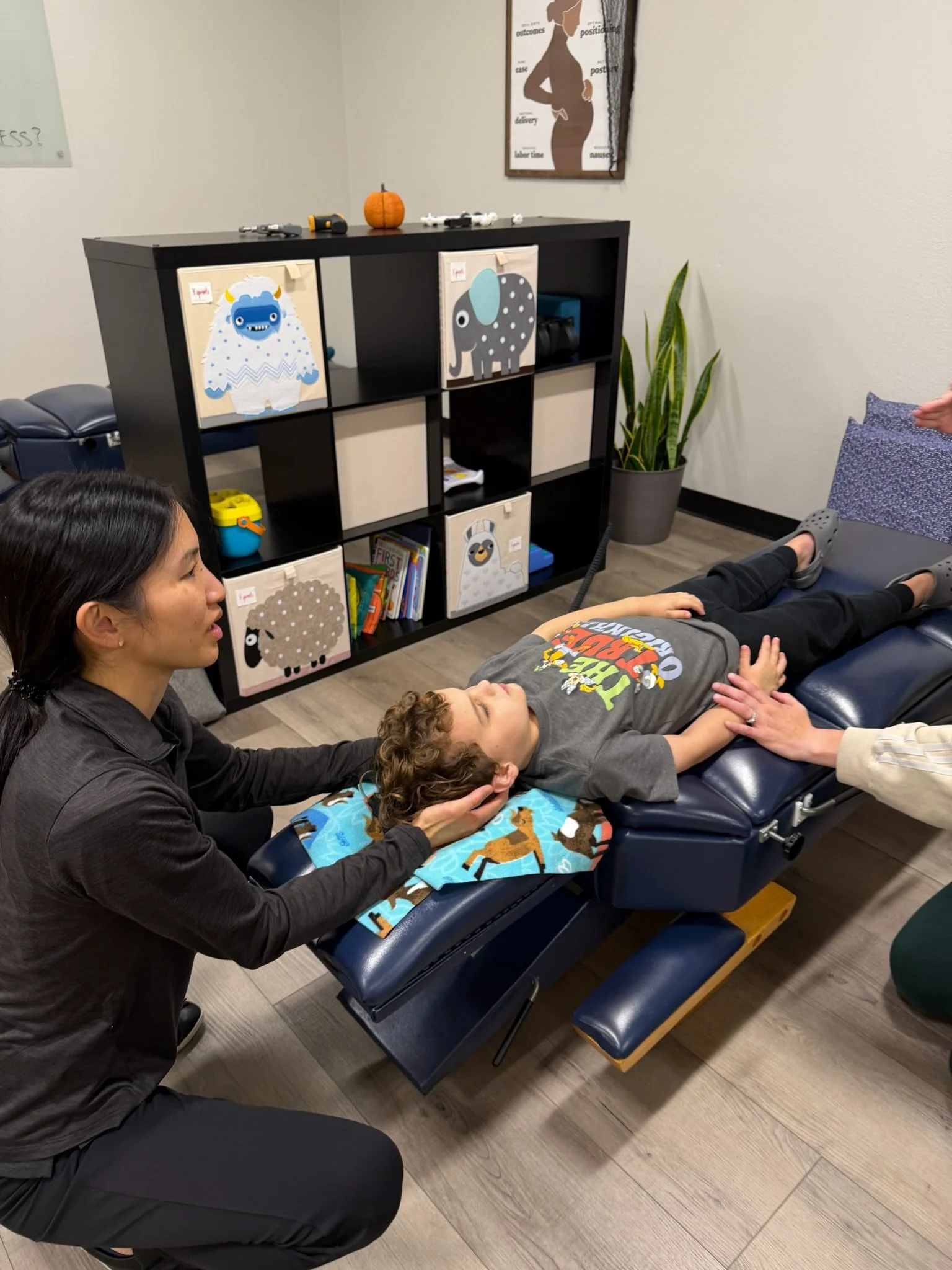
4. We move with your child, not against them. A sensory seeker doesn't want to lie still on a table, and we don't ask them to. We adjust kids while they climb, play, sit on your lap, or wander the room.
5. We support your OT and therapy team. Our goal is a calmer, more organized nervous system, so the sensory diet and therapy strategies your child already uses can work better.
What a care plan looks like
Our typical plan for autistic kids:
• Length: 3 months to start
• Frequency: 3 visits per week
• Progress exams: every 12 visits, so we can check how your child is changing and adjust the plan
The nervous system learns through repetition. Research on how the brain rewires itself shows that repetition, intensity, and time all matter (Kleim & Jones, 2008). That research comes mostly from rehabilitation, so we use it as a guide and adjust each child's plan to their progress.
One family's story
One mom was nervous to bring her autistic son to a chiropractor. She pictured the adult version, rough and intense, and didn't want him hurt. So she came in first just to ask questions and see how we work.
Her son is a busy, always-moving kid with a short attention span. During visits he plays with toys, gets distracted, and moves around the room, and we adjust him right where he is.
About four months into care, she shared that things had started to "click." His eye contact increased, he began saying more words, he could name parts of his body, and he seemed to understand his world more. And he loves coming in.
Every child is different, and results vary. We share stories like this with families' permission to show what progress can look like.
Frequently asked questions
Is sensory seeking a sign of autism? Sensory seeking can happen in any child, and it's especially common in autism and ADHD. If you're concerned about your child's development, talk with your pediatrician about an evaluation.
Will chiropractic care stop my child's sensory seeking? We can't promise that, and we'd be wary of anyone who does. Our goal is a calmer, better-regulated nervous system. Many families notice the seeking becomes less urgent and their child settles more easily, but every child responds differently.
Should we stop OT or our sensory diet? No. Keep going. We see our care as a complement to OT, not a replacement.
My child never stops moving. Can you still adjust them safely? Yes. Our techniques are gentle and quick, and we adjust kids while they play, climb, or sit with you. We never hold a child down or force a position.
How soon will we notice a difference? Some families notice changes within the first few weeks; for others it takes longer. Progress exams every 12 visits help us track how your child is changing.
Your next step
If your living room has turned into a crash pad and you want to understand what your child's body is really asking for, we'd love to meet your family.
Your Initial Visit happens in two parts:
1. Visit 1: a conversation about your child's history, a gentle chiropractic exam, and INSiGHT nervous system scans
2. Visit 2: we walk you through what we found and recommend a care plan, so you can decide what's right for your family
We're located at 8799 Balboa Ave in Kearny Mesa, San Diego. We accept HSA and FSA cards.
Proudly supporting kids with Autism across Clairemont, Mira Mesa, Scripps Ranch, Kearny Mesa, La Jolla, and all of San Diego
Sprout Family Chiropractic | Pediatric + Nervous System Experts
Disclaimer: This article is for educational purposes and is not intended as medical advice. Always consult your child’s healthcare provider for personalized guidance.