
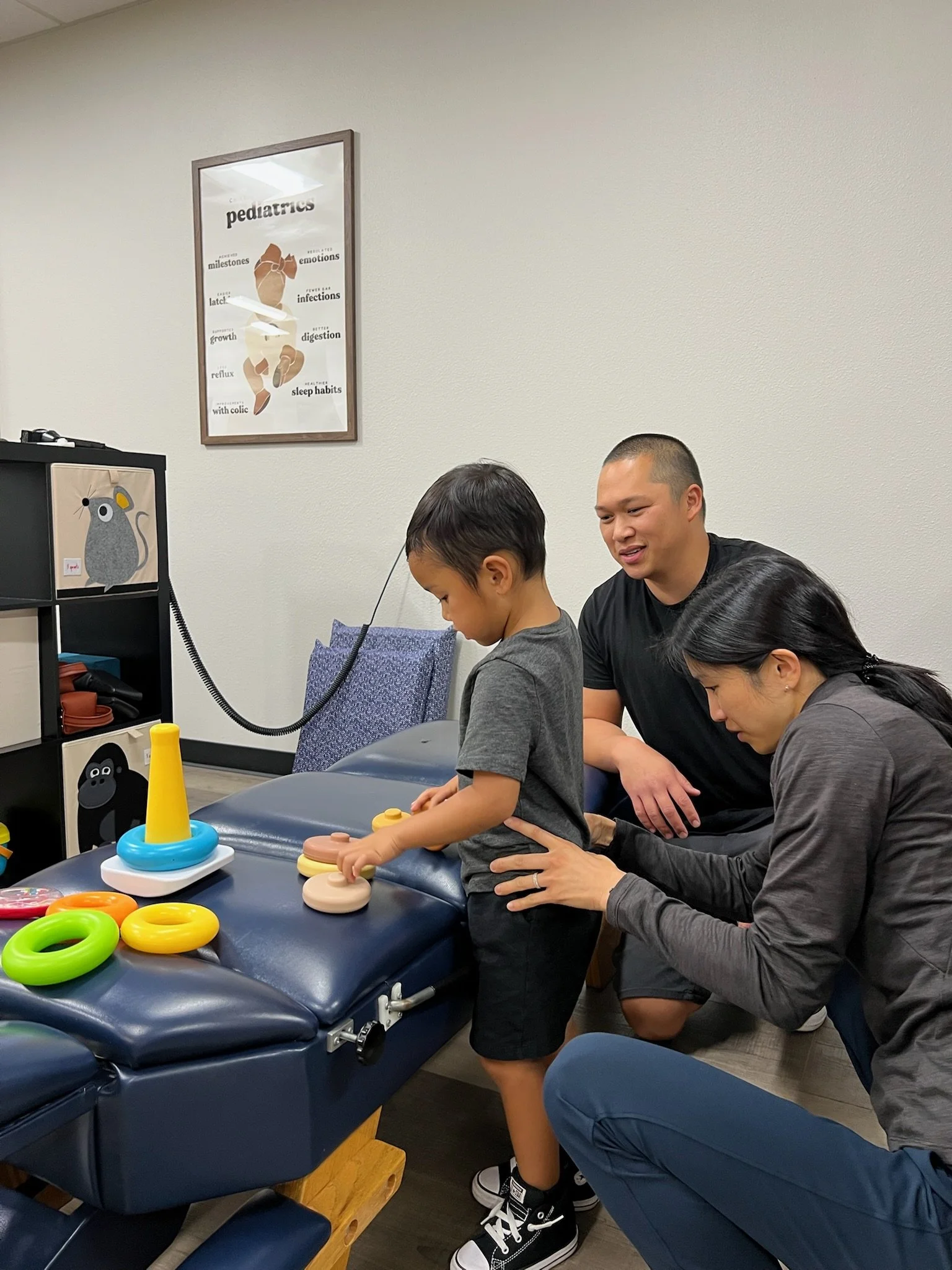
When you picture a chiropractor, you might picture the videos online: someone lying face-down on a table, a quick twist, a loud crack. Now picture your child. The one who won't let anyone touch their head. The one who can't tell you if something hurts. The one who melts down at the dentist.
Of course you're hesitant. Asking "is this safe?" isn't being difficult. It's being a good parent.
Many of the parents we work with felt exactly the same way before their first visit. Some called us first just to ask questions before deciding anything. We think that's smart, and we welcome it.
The short answer
Pediatric chiropractic looks very different from adult chiropractic. It uses far less force, often about the pressure you'd use to test a ripe tomato, and there's no twisting or cracking. Research suggests serious problems are rare, and the most common reactions are mild and short-lived, like brief fussiness or soreness. The research also has real limits, which we explain below. What matters most is choosing a chiropractor trained specifically in pediatrics, who does a thorough exam first and knows when to refer you to your child's doctor.
What the safety research says
We want you to have the full picture, not just the reassuring parts.
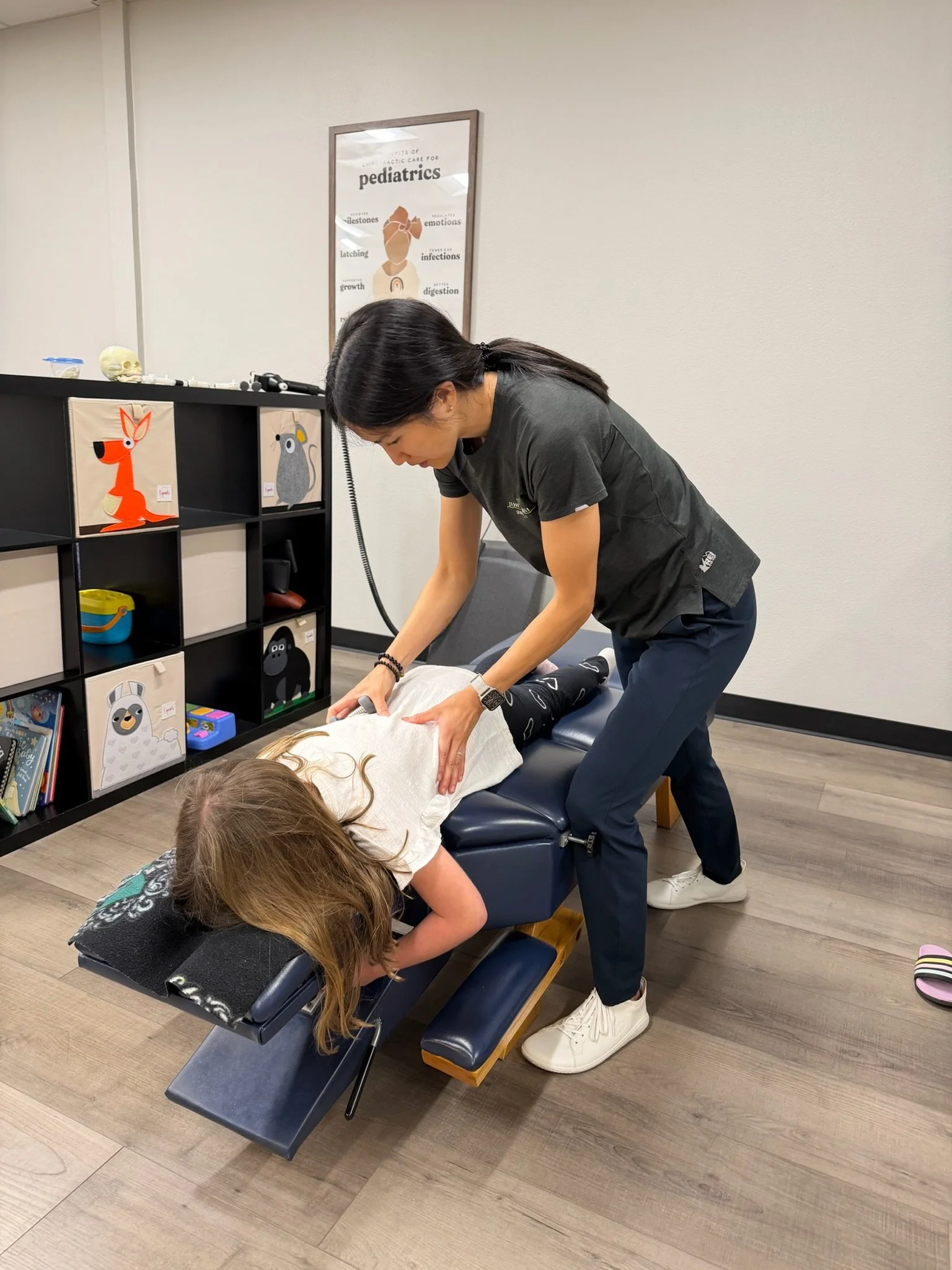
Mild reactions are the most common. A study of nearly 700 children under 3, covering more than 5,000 chiropractic visits, found that about 1 in 100 children had a reaction their parents noticed, mostly increased crying or restlessness. All of them resolved within 24 hours, and there were no serious complications.
Serious problems are rare, but the research has limits. A 2020 review of the safety research in children under 10 found that most reported reactions were mild and temporary. It found very few serious events in the published literature. The authors were also honest that most studies weren't designed to catch rare problems, so the true risk of serious events isn't precisely known.
A good exam matters as much as a gentle adjustment. One of the cases in that review involved a baby whose underlying medical condition wasn't caught early. That's why a careful history and exam, and knowing when something needs a medical workup, are a core part of safe pediatric care.
We'd rather tell you this plainly than promise "100% safe." No form of care, including medication and therapy, can promise that.
Pediatric chiropractic is not adult chiropractic
Most of the published safety research looks at spinal manipulation in general. The techniques we use with kids are gentler still.
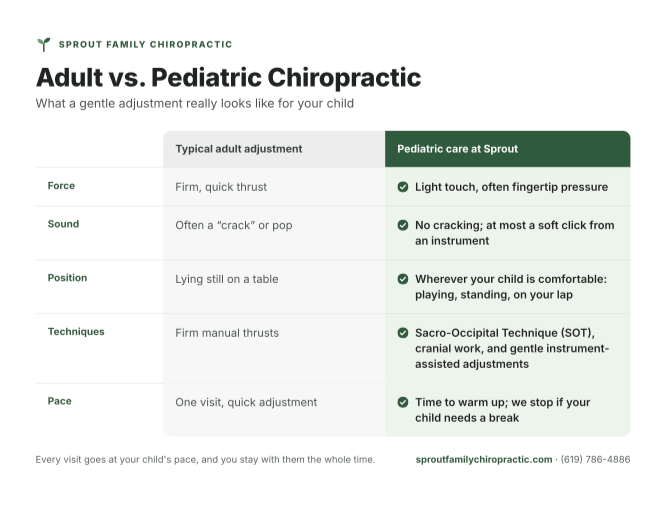
We're trained through the ICPA and PX Docs, which focus specifically on caring for babies and children, including kids with neurodevelopmental differences.
What a visit at Sprout actually looks like
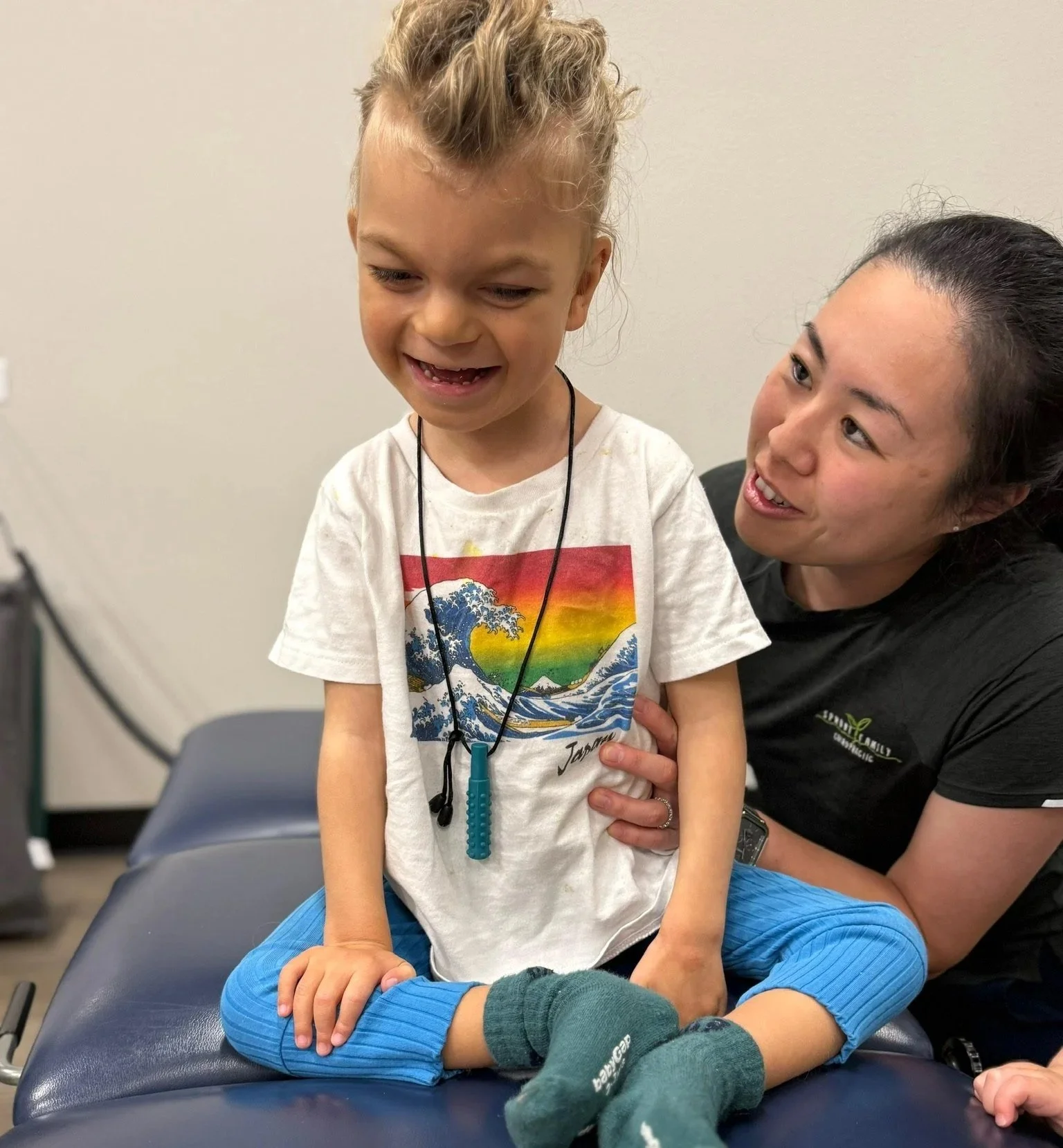
Here's what to expect, especially if your child is sensory-sensitive or nonverbal.
Before you arrive. You'll fill out an intake form about your child's history, sensitivities, triggers, and what helps them feel calm. Tell us everything: the songs they love, the sounds they hate, the toy they can't leave home without.
When you walk in. Our office is calm and kid-friendly, with toys, quiet spaces, and our office dog, Mabel. Your child can explore at their own pace. There's no rush to get on a table, and many kids never do.
During the exam. We talk to your child, not just about them, whether or not they speak. We explain what we're doing before we do it. If your child needs to move, play, or take a break, that's fine.
During the adjustment. We adjust kids wherever they're most comfortable: sitting on your lap, standing at a toy, or lying down if they like. Adjustments are quick and gentle. Some of our instruments make a soft click, so we show them to your child first and let them hear the sound before we begin. For a child who doesn't like being touched, we may spend the first visits simply building trust.
If your child is nonverbal. We watch their body closely: facial expression, muscle tension, breathing, whether they lean in or pull away. Many parents tell us they can see the moment their child relaxes. If your child signals "no," we listen.
Laser therapy, if it's part of the plan. The lasers we use produce no heat, and most kids don't feel anything. They usually keep playing the whole time.
You're there the whole time. You can hold your child, sit next to them, and ask questions at any point.
Questions to ask any pediatric chiropractor
Whether you choose us or someone else, these questions will help you find a safe fit for your child:
1. What pediatric training do you have? Look for specific training in caring for children, such as through the ICPA or PX Docs, not just a weekend course.
2. Do you have experience working with neurodivergent kids? Experience with autism changes everything about how a visit runs.
3. What happens if my child won't hold still or lie down? The answer should be "that's fine," not "we'll hold them."
4. How much force do you use, and does it make a cracking sound? For young children, the answer should be very little, and usually no.
5. What does your exam include, and when do you refer to a medical doctor? A safe provider knows the warning signs that need a medical workup.
6. Can I stay with my child the whole time? The answer should always be yes.
7. How do you track progress? Look for regular re-checks and clear goals, not open-ended visits with no plan.
One family's story
One mom brought in her 6-year-old daughter, who has profound autism and is nonverbal. Trust mattered more than anything, because her daughter can't say what she likes or doesn't like.
What stood out to her most was how we treated her daughter. In her words, we presume competence: we speak to her, include her, respect her, and give her the time and space she needs. For the parent of a nonverbal child, she said, that means more than she can put into words.
Her daughter can't describe her adjustments, but she shows how she feels. She works with us willingly, and there are moments when her face says, "Ooo, that feels good!" She loves coming in, and she's especially fond of Mabel, our office dog.
Every child is different, and results vary. We share stories like this with families' permission to show what progress can look like.
Frequently asked questions
Does a pediatric adjustment hurt? No. Pediatric adjustments use very light pressure. Most kids don't react at all, and many seem to enjoy it. Some children are a little fussy or sore afterward, which usually passes within a day.
Do you crack children's necks? No. We don't use twisting or cracking techniques with children. Our methods are gentle and low-force.
What if my child has a meltdown during the visit? That's okay, and it happens. We pause, give your child space, and follow their lead. Some kids need a few visits just to get comfortable, and we build that into the plan.
Is it safe to combine chiropractic with my child's other therapies and medications? Yes. We work alongside OT, speech, ABA, PT, and your child's medical care. We never ask families to stop a medication or therapy.
Can I ask questions before booking? Yes. Call us at (619) 786-4886 and we're happy to talk through your questions by phone before you book.
Your next step
You don't have to decide anything today. If you want to see for yourself how we work with kids like yours, start with an Initial Visit.
Your Initial Visit happens in two parts:
1. Visit 1: a conversation about your child's history, a gentle chiropractic exam, and INSiGHT nervous system scans
2. Visit 2: we walk you through what we found and recommend a care plan, so you can decide what's right for your family
We're located at 8799 Balboa Ave in Kearny Mesa, San Diego. We accept HSA and FSA cards.
Not ready yet? Call (619) 786-4886 with your questions, or watch a real visit.
Read More Articles Like This
Is My Child Stuck in Fight-or-Flight? 12 Signs in Autistic Kids
Sensory Seeking in Autistic Kids: Why They Crash, Spin, and Never Stop Moving
Autism and ADHD Together: Why Focus Is So Hard (and What Helps)
Why Is My Autistic Child Always Constipated? A Nervous System Guide for San Diego Parents
Sources
Proudly supporting kids with Autism across Clairemont, Mira Mesa, Scripps Ranch, Kearny Mesa, La Jolla, and all of San Diego
Sprout Family Chiropractic | Pediatric + Nervous System Experts
Disclaimer: This article is for educational purposes and is not intended as medical advice. Always consult your child’s healthcare provider for personalized guidance.