
It's day four. You've tracked it on the calendar, or in your head, because you always do. Your child is more irritable than usual. They're climbing, crashing, or melting down over things that were fine last week. Maybe they won't sit at the table. Maybe they can't tell you their belly hurts, but you can see it in how they move.
You've been told to add fiber and water. You've tried the pear juice, the probiotics, the special diet. You may have a bottle of Miralax in the cabinet that you're giving more often than you ever expected to.
If this sounds like your home, you are not alone, and you are not doing anything wrong. Constipation is one of the most common challenges we see in the autistic kids who come to our practice, and it's rarely just a "tummy problem."
The short answer
Chronic constipation is very common in autistic children, and research shows it is closely tied to how the nervous system runs digestion. When a child's body spends much of the day in a stressed, "fight-or-flight" state, the gut gets the signal to slow down. Supporting the nervous system, alongside your child's medical care, is often the missing piece for families who feel stuck in a cycle of laxatives and bad days.
How common is constipation in kids with autism?
Very common. A 2018 review in Autism Research looked at nearly four decades of studies and found constipation in a median of about 22% of autistic people, with some studies reporting much higher rates. In one study of 120 autistic children and teens, 42.5% met the criteria for functional constipation.
An Australian pediatric constipation clinic found that its autistic patients tended to have symptoms that started earlier and lasted longer than other children's, and some showed signs of slow-moving bowels.
In other words: if your child has autism and is always constipated, you are describing something researchers see over and over. It's not your cooking, and it's not your parenting.
Why constipation and behavior are connected
Many parents notice that the worst days for meltdowns, sleep, or focus line up with the days their child hasn't gone. That's not in your head. A 2024 review in Nature Reviews Gastroenterology & Hepatology noted that gut problems in autism have been repeatedly linked with more irritability, more rigid behavior, and more aggression.
Think about it from your child's point of view. A full, uncomfortable belly is a constant low-grade alarm. For a child who is nonverbal, or who has trouble noticing and naming body signals, that alarm comes out as behavior: pacing, crashing into furniture, refusing food, waking at night, or shutting down.
The nervous system piece most parents haven't heard

Your child's digestion is run by the autonomic nervous system, the part that works automatically, without thinking. It has two main modes:
• "Rest and digest" (parasympathetic): the body feels safe, so it puts energy into digestion, sleep, growth, and learning. The vagus nerve is the main highway carrying these signals between the brain and the gut.
• "Fight or flight" (sympathetic): the body feels under threat, so it pulls energy away from digestion and toward staying on alert. The gut slows down.
Many autistic kids spend much more time in fight-or-flight than other children. Noise, light, textures, transitions, and social demands can keep the body on high alert all day. The same 120-child study found that autonomic nervous system function and gut problems appeared intertwined in autistic children, and that gut problems, anxiety, and autonomic changes tend to cluster together.
There's a second layer, too. Many autistic kids have differences in interoception, the sense that tells us what's happening inside our bodies, like hunger, fullness, or the need to use the bathroom. As the University of Florida's autism center explains, a child who doesn't clearly feel the "I need to go" signal may hold stool without realizing it, which makes constipation worse over time.
So constipation in an autistic child is often a nervous system story: a body stuck on high alert, a gut that's been told to slow down, and a brain that isn't getting clear signals back.
What families usually try first (and why it may not hold)
By the time families reach us, most have already tried:
• Fiber, water, prunes, and pear juice
• Probiotics and supplements
• Gluten-free, dairy-free, or other diet changes
• Functional medicine testing
• Daily Miralax or other stool softeners
These can all be helpful, and some are medically necessary. Please keep working with your pediatrician or GI specialist, and don't stop or change any medication without them.
But many parents tell us the same thing: "It works while we're doing it, and the moment we stop, we're right back where we started." That's often because these approaches support the gut itself, while the nervous system that controls the gut is still stuck in stress mode.
How we approach constipation at Sprout Family Chiropractic
To be clear: we do not treat or cure autism. What we do is focus on the nervous system and the everyday challenges that make life harder for your child, and constipation is one of the most common.
1. We start by measuring, not guessing. At your child's first visit, we use INSiGHT scans, quick, non-invasive tools that show how your child's nervous system is handling stress and where tension is stored. That gives us a baseline, and later scans show you how things are changing.
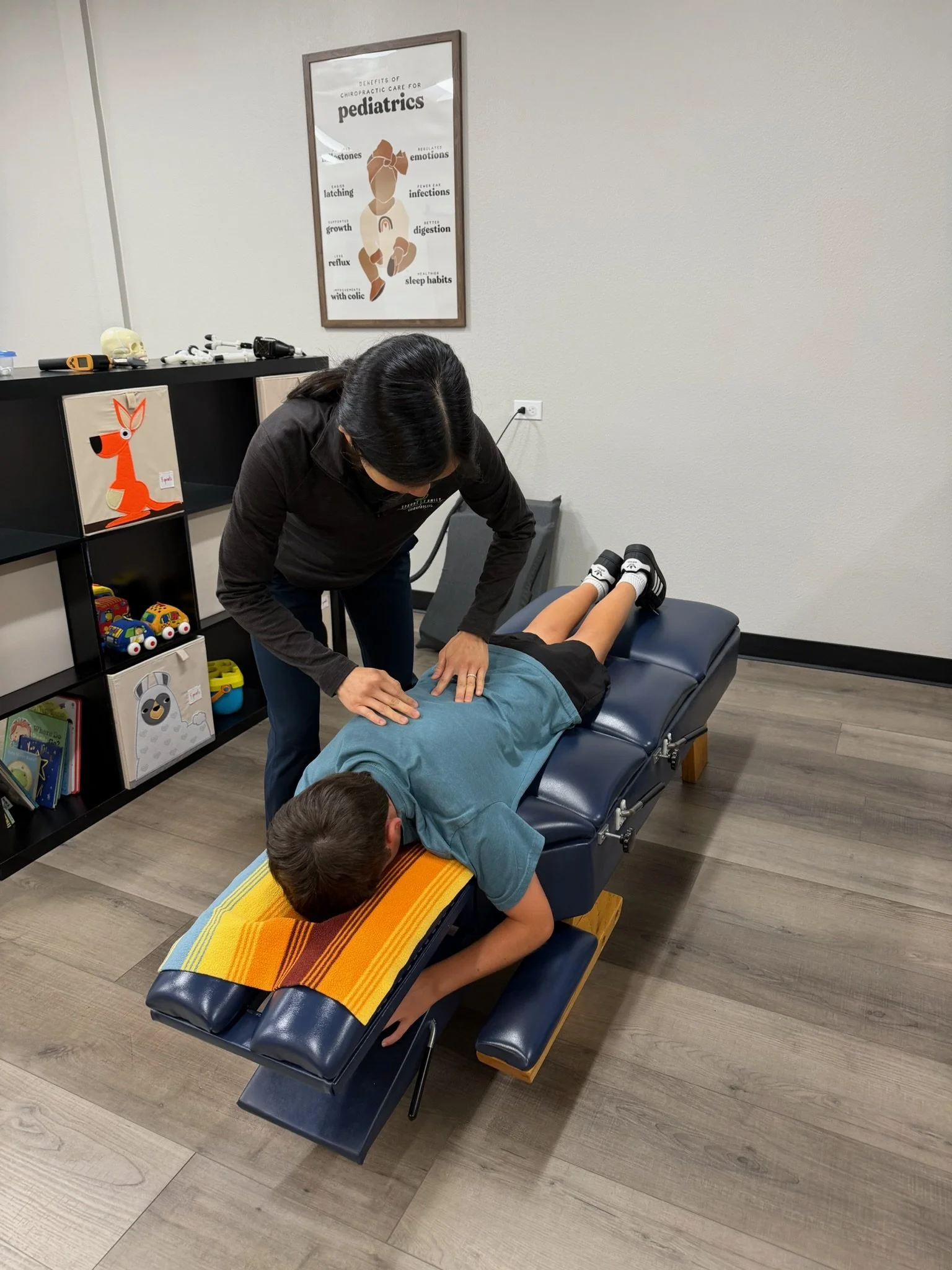
2. We use gentle, specific techniques made for kids. Both of us are trained through the ICPA and PX Docs, and we use Sacro-Occipital Technique (SOT), cranial work, and gentle instrument-assisted adjustments. These are light-touch, low-force methods. There's no twisting or cracking, and many adjustments happen while your child is playing or sitting on your lap.
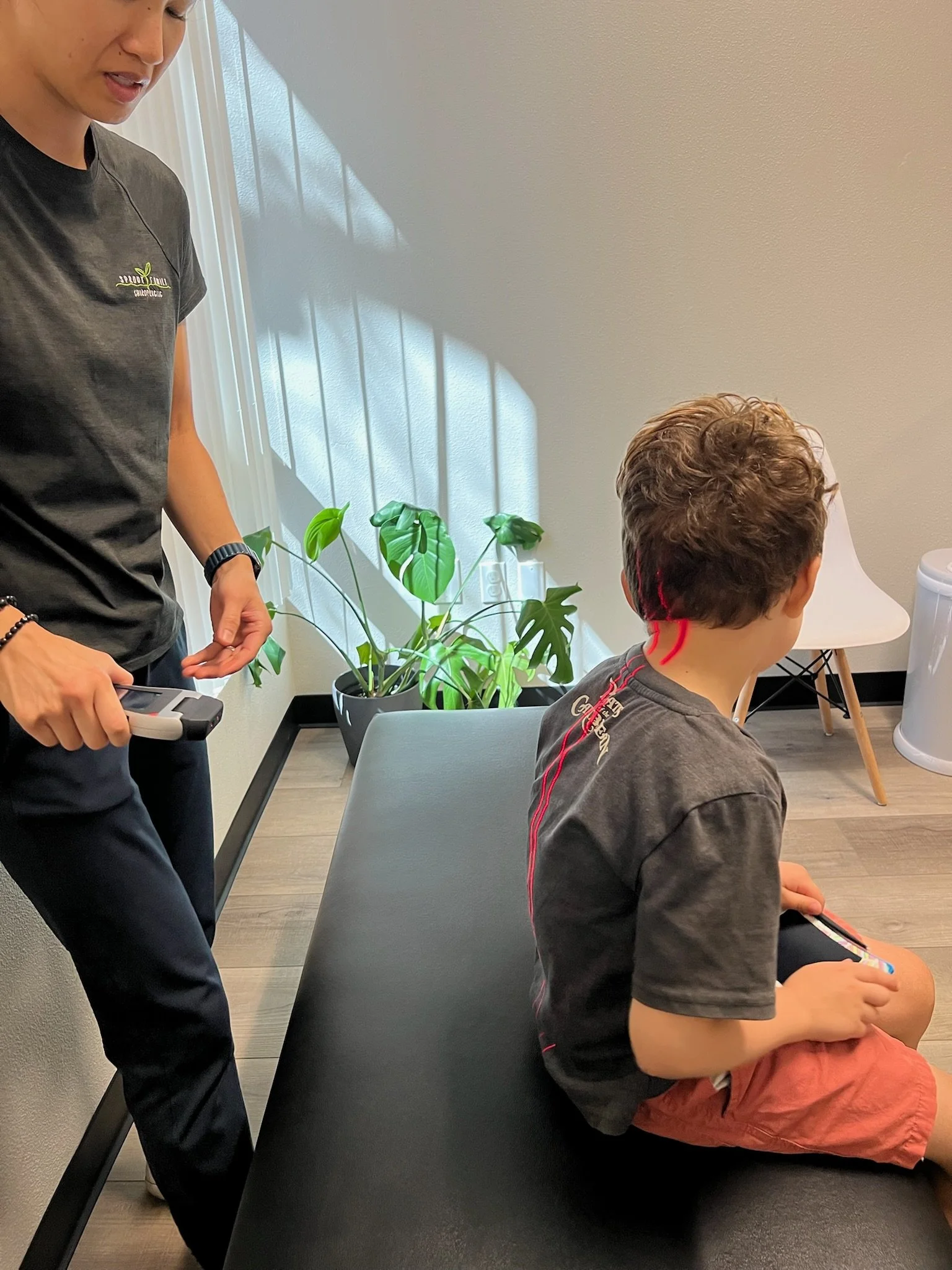
3. We pair adjustments with low-level laser therapy when it's a good fit. We use the Erchonia XLR8 and GVL lasers, which produce no heat. We use them to support mitochondrial health, the energy-making part of every cell, and the body's natural healing. Most kids don't feel anything and play right through their session.
4. We go at your child's pace. Sensory-sensitive and nonverbal kids need time to feel safe. We never rush, we never force, and we talk to your child directly, not just about them. Trust is part of the care.
5. We support the therapies you already have. Many of our families also do ABA, OT, speech, or PT. We see our role as helping your child's body become calm enough for everything else to stick.
What a care plan looks like
The nervous system changes through repetition, not one visit. Our typical care plan for autistic kids:
• Length: 3 months to start
• Frequency: 3 visits per week
• Progress exams: every 12 visits, so we can check how your child is changing and adjust the plan
Why three visits a week for three months?
Because the nervous system learns through repetition.
Every time a signal travels the same pathway, that pathway gets a little easier to use. Physiologists call this synaptic facilitation. TheGuyton and Hall Textbook of Medical Physiology, the standard physiology text in medical schools, describes it as part of how the brain forms memories and learned patterns. A nervous system that has spent years in fight-or-flight has, in a sense, practiced that pattern very well.
Researchers who study how the brain rewires itself have summarized what drives lasting change. In a widely cited 2008 paper, neuroscientists Jeffrey Kleim and Theresa Jones laid out ten principles of experience-dependent neural plasticity. Three of them shape how we schedule care:
• Repetition matters: a new pattern needs to be reinforced many times before it holds.
• Intensity matters: more frequent input tends to produce bigger changes than the same input spread thin.
• Time matters: lasting change unfolds over weeks and months, not days.
That's why we front-load care. Three visits a week gives your child's nervous system frequent, consistent input. When visits are spread a week or two apart, the old stress pattern has time to take back over in between. Three months gives enough time to see whether changes are holding, and progress exams every 12 visits (about every four weeks) let us check how your child is changing and adjust the plan.
To be transparent: these principles come mostly from rehabilitation research, such as recovery after brain injury. No study has tested this exact schedule for autistic children. Our plan is how we apply well-established principles of how the nervous system learns, and we adjust it to each child's scans and progress.
We know that's a real commitment of time and money. We'd rather be honest about what it takes than promise a quick fix that won't last. Most families tell us that seeing the scans improve alongside the changes at home is what keeps them going.
One family's story

One of our families started care for their 6-year-old daughter, who has profound autism and is nonverbal. They came in hoping to help her body move out of a constant fight-or-flight state and to ease her ongoing constipation. After her first INSiGHT scan, they committed to a three-month plan.
Three months in, her mom described a calmer, more regulated child. Bedtime got easier. They noticed more focus, more eye contact, more engagement with the people around her, and improvement in her constipation.
The moment her mom treasured most was a small one. Her daughter, who had always wanted to eat alone in her bed, started bringing her favorite foods into the living room to eat with the family. In her mom's words, that may sound small to someone else, but for their family it was huge.
Every child is different, and results vary. We share stories like this with families' permission to show what progress can look like.
When to call your doctor right away
Constipation can sometimes signal something that needs medical care. Call your pediatrician promptly if your child has:
• Blood in their stool
• Vomiting, especially green or yellow
• A swollen, hard belly
• Fever with belly pain
• Weight loss or refusing to eat
• No bowel movement for a week or more
Frequently asked questions
Can chiropractic care help my autistic child's constipation? We don't treat constipation directly. We focus on the nervous system that coordinates digestion. Many families in our practice notice improvements in constipation along with calmer moods and better sleep, but every child responds differently.
Is chiropractic safe for a child with autism? Pediatric chiropractic uses very light pressure, much less than adult care. We're trained specifically in pediatric techniques, and we adapt every visit to what your child can tolerate that day.
Should I stop Miralax if we start care? No. Keep following your pediatrician's guidance. If things improve, any change to medication should be made with your doctor.
How soon will we see changes? Some families notice changes in the first few weeks; for others it takes longer. That's why we do a progress exam every 12 visits, so you can see how things are changing, not just guess.
My child is nonverbal and doesn't like being touched. Can you still help? Yes. Many of the kids we see are nonverbal or touch-sensitive. We go slowly, let your child explore the room, and adjust while they play or sit with you.
Your next step
If you're tired of tracking bowel movements on the calendar and bracing for the hard days that follow, we'd love to meet your family.
Your Initial Visit happens in two parts:
1. Visit 1: a conversation about your child's history, a gentle chiropractic exam, and INSiGHT nervous system scans
2. Visit 2: we walk you through what we found and recommend a care plan, so you can decide what's right for your family
We're located at 8799 Balboa Ave in Kearny Mesa, San Diego. We accept HSA and FSA cards.
Read more articles like this
The Gut–Brain–Immune Connection in Kids
The Vagus Nerve and Your Child's Brain
Why Stress Hits Neurodivergent Kids Differently
Sources
• Holingue et al., 2018, Autism Research: GI symptom prevalence review
• Ferguson et al., 2017, Autism Research: GI symptoms and autonomic function in 120 autistic youth
• Pang & Croaker, 2011, Pediatric Surgery International: constipation in autistic children
• Nature Reviews Gastroenterology & Hepatology, 2024: autism and the GI tract
• University of Florida Center for Autism: constipation and interoception
• Hall JE, Hall ME. Guyton and Hall Textbook of Medical Physiology. Elsevier; chapter on memory and synaptic facilitation
Proudly supporting kids with Autism across Clairemont, Mira Mesa, Scripps Ranch, Kearny Mesa, La Jolla, and all of San Diego
Sprout Family Chiropractic | Pediatric + Nervous System Experts
Disclaimer: This article is for educational purposes and is not intended as medical advice. Always consult your child’s healthcare provider for personalized guidance.