

It's 2:14 a.m. You hear the door, then footsteps, then a small voice, or a hum, or the thud of a body bouncing on the bed. Your child is wide awake, and they're not going back to sleep anytime soon.
Or maybe nights are okay, but mornings start at 4:45. Every day. Weekends too. You've tried later bedtimes, earlier bedtimes, blackout curtains, and white noise. You've lost track of the last time you slept past sunrise.
And now the clocks are about to fall back. For most families, that means an extra hour of sleep. For you, it might mean your 5 a.m. riser becomes a 4 a.m. riser.
If that sounds like your house, this post is for you.
The short answer
Sleep problems are very common in autistic kids, and night waking and early rising are two of the hardest. The causes are usually layered: differences in the body's sleep hormone, a nervous system that has trouble shifting into rest mode, sensory sensitivities, and discomfort like constipation. Small, gradual changes can help your child get through the time change. Supporting a calmer nervous system can help the body settle more easily, night after night.
How common is it?
Very. According to Vanderbilt University Medical Center, 50 to 80 percent of parents of autistic children report sleep problems. At least a third of autistic children have night wakings, and in children ages 2 to 5, sleep problems are about twice as common as in other kids.
If you're exhausted, there's a reason. You're not doing bedtime wrong.
Why autistic kids wake at night and rise early
The body's sleep hormone may work differently
Melatonin is the hormone that tells the body it's time to sleep. It rises in the evening as light fades and helps keep sleep steady through the night.
A 2011 systematic review by Rossignol and Frye found that all nine studies measuring melatonin in autistic people reported at least one abnormality, such as below-average levels or an off-rhythm daily cycle. When the body's sleep signal is weaker or mistimed, it's harder to stay asleep and easier to wake too early.
A nervous system that won't shift into rest mode
Sleep happens in "rest-and-digest" mode. A child whose nervous system spends much of the day in fight-or-flight may have trouble making that shift at night. Even after falling asleep, a body on alert sleeps lightly, so small noises or discomfort wake it up. (We explain this pattern in Is My Child Stuck in Fight-or-Flight?)
Sensory sensitivities
The hum of the fridge, a sliver of light under the door, pajama seams, the feel of the sheets, or a room that's a little too warm. Things most kids sleep through can wake a sensory-sensitive child, especially in the lighter sleep of the early morning hours.
A body that doesn't feel good
Constipation and tummy discomfort are common in autistic kids, and they often get worse lying down. Many kids can't tell you their belly hurts. They just wake up and can't settle. (More in Why Is My Autistic Child Always Constipated?)
Early light
Morning light is a powerful wake-up signal. Kids who are sensitive to light may wake at the first hint of dawn. That's one reason the fall time change hits some families so hard.
Surviving the time change on November 1
Clocks fall back at 2 a.m. on Sunday, November 1. Your child's body clock doesn't know that. So a child who usually wakes at 6:00 will suddenly be waking at 5:00 by the clock, and bedtime will feel an hour too early.
The gentlest fix is to shift your child's schedule a little at a time before the change. Sleep experts at Children's National Hospitalsuggest moving young children's schedules by 10 to 15 minutes at a time. For kids who find change hard, starting about five days early and moving in small steps tends to go more smoothly.
Here's an example for a child whose usual bedtime is 7:30:
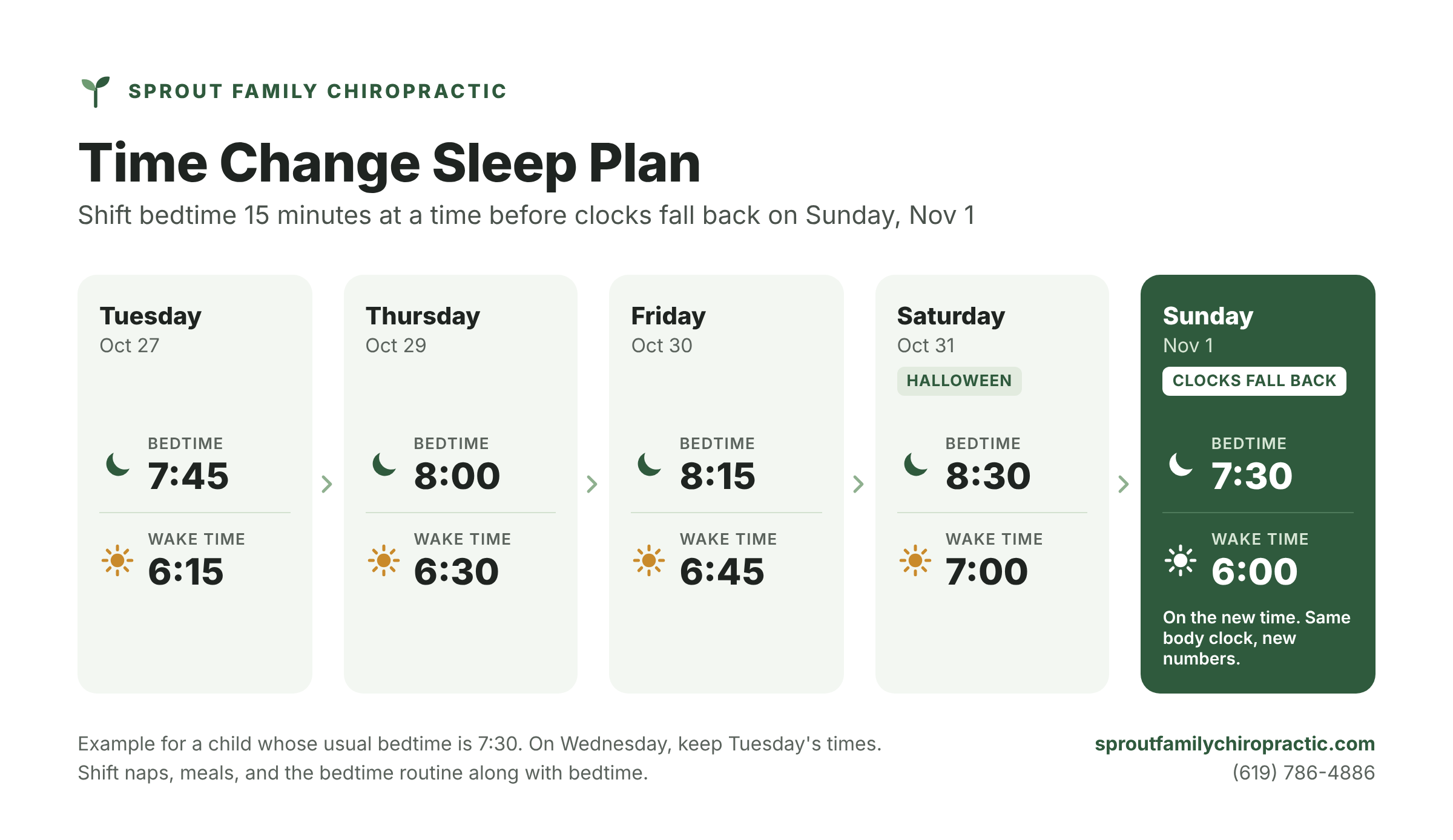
Shift naps, meals, and the bedtime routine along with bedtime, so the whole day moves together.
A few tips for the change itself:
• Keep the routine identical. Same steps, same order, same songs. Only the clock moves.
• Prepare your child. A simple social story or visual schedule can help: "The clock is changing. Bedtime is still after bath and books."
• Use light on purpose. Get outside in morning light after wake-up time, and keep evenings dim, with screens off an hour before bed.
• Plan for Halloween. It falls the night before the change this year. If trick-or-treating means a late, overstimulating night, build in extra calm time afterward.
• Give it a week or two. Most kids settle into the new time within a couple of weeks. Autistic kids may take longer, and that's okay.
Everyday tips for night waking and early rising
• Make the room truly dark. Blackout curtains, and tape over glowing chargers or electronics.
• Use a visual wake-up signal. An "okay-to-wake" clock that changes color shows your child when morning has really started, which works even for kids who don't read or speak.
• Keep early hours boring. If your child wakes before the agreed time, keep lights low and activities quiet. Save screens and breakfast for after wake-up time.
• Keep wake-up time consistent, even on weekends. It anchors the body clock.
• Calm the senses. White noise to cover household sounds, a comfortable room temperature, and tag-free pajamas.
• Ask your child's OT about deep pressure or a weighted blanket at bedtime, if it suits your child.
• Look at the belly. If night waking comes with constipation, address the constipation with your pediatrician.
• Talk to your pediatrician about melatonin before trying it. Research shows it can help some autistic kids sleep longer, but it's a decision for your child's doctor, not one to make on your own.
What families usually try first
By the time families reach us, most have tried several of these:
• Strict bedtime routines and visual schedules
• Blackout curtains, white noise, and weighted blankets
• Melatonin or other sleep supplements
• Magnesium, diet changes, or cutting screens
• Behavioral sleep programs
• Sleep medication prescribed by their doctor
Many of these help, and we encourage families to keep what's working. What parents often tell us is that the routine is perfect, the room is perfect, and their child still wakes at 2 a.m. That's often a sign that the nervous system underneath hasn't learned to settle.
How we approach sleep at Sprout Family Chiropractic

We do not treat or cure autism, and we don't treat sleep disorders. We focus on the nervous system and the everyday challenges that come with it, and sleep is one of the most common reasons families come to us.
1. We look at the whole picture. INSiGHT scans at your child's first visit show how their nervous system is handling stress. We also ask about digestion, sensory patterns, and daytime regulation, because they often travel together with sleep.
2. We help the body shift into rest mode. We use Sacro-Occipital Technique (SOT), cranial work, and gentle instrument-assisted adjustments, all aimed at helping the nervous system spend less time on alert. No cracking, and always at your child's pace.
3. We add low-level laser therapy when it fits. We use the Erchonia XLR8 and GVL lasers, 5 to 10 minutes a session, to support mitochondrial health and the body's natural healing.
4. We support the rest of your child's care. We work alongside your pediatrician, OT, and any sleep plan you already have.
What a typical care plan looks like
The nervous system changes through repetition, not one visit. Our typical plan for autistic kids starts with 3 months of care, 3 visits per week, with progress exams every 12 visits. We tailor every plan to the child.
One family's story
One family came to us with a son who had never slept longer than three hours at a time. Not once. Like so many parents of kids who wake through the night, they were running on empty.
After starting care at Sprout, they saw a huge change in his sleep. And the change didn't stay at night. They also noticed improvements in his behavior, his digestion, and how he showed up in his therapy sessions. When sleep gets better, so much else can follow.
Every child is different, and results vary. We share stories like this with families' permission to show what progress can look like.
Frequently asked questions
How long will it take my child to adjust to the time change? Most kids settle within a week or two. Autistic kids may take longer, especially if routines are thrown off at the same time, like the holidays. Starting the shift a few days early helps.
Should I just keep my child up later to fix early rising? Not always. An overtired child often sleeps worse and can wake even earlier. Small, gradual shifts and a consistent wake-up time usually work better than one big change.
Is it safe to give my child melatonin? Talk with your pediatrician first. Research shows melatonin can help some autistic kids sleep longer, but the right choice, amount, and timing depend on your child.
Can chiropractic care help my child sleep? We don't treat sleep disorders. We focus on helping your child's nervous system spend less time on alert, which plays a big role in sleep. Many families in our practice notice easier bedtimes and fewer night wakings, but every child responds differently.
When should I talk to a doctor about my child's sleep? Talk to your pediatrician if your child snores loudly, gasps or pauses in breathing during sleep, is very sleepy during the day, or if sleep problems are affecting your family's health. Some sleep problems have medical causes that need a workup.
Your next step
If you're running on broken sleep and nothing you've tried has stuck, we'd love to help you look at what's happening in your child's nervous system.
Your Initial Visit includes a gentle exam and INSiGHT nervous system scans, followed by a second visit to review results and talk through a plan. See what to expect at your child’s first visit.
We're located at 8799 Balboa Ave in Kearny Mesa, San Diego. We accept HSA and FSA cards. Have questions first? Call us at (619) 786-4886.
Read more articles like this
Sources
• Children's National Hospital: how to adjust your child's sleep schedule for the time change
Proudly supporting kids with Autism across Clairemont, Mira Mesa, Scripps Ranch, Kearny Mesa, La Jolla, and all of San Diego
Sprout Family Chiropractic | Pediatric + Nervous System Experts
Disclaimer: This article is for educational purposes and is not intended as medical advice. Always consult your child’s healthcare provider for personalized guidance.