
You've bought the potty, the sticker chart, the books with the cartoon frogs. You've done the three-day method, the naked weekends, the timer every 30 minutes. Your child will sit on the toilet, sometimes. But nothing happens, and five minutes after the diaper goes back on, it's full.
Meanwhile, the preschool or TK classroom wants them trained. Other kids their age have been out of diapers for a year or more. And well-meaning relatives keep saying, "Just be consistent."
If potty training feels like it's never going to click, you are far from alone. And it's probably not about consistency.
The short answer
Potty training usually takes longer for autistic kids, and that's not a parenting failure. To use the toilet, a child has to feel the signal that they need to go, relax the right muscles, tolerate the bathroom's sensory experience, and communicate the need. Each of those depends on the nervous system, and constipation often makes everything harder. Treating constipation, working with your child's senses and communication, and supporting a calmer nervous system can help potty training finally make progress.
How common are potty training delays in autism?
Very common. A 2017 study of 583 autistic children found that only about 79% were dry during the day by age 5, compared with about 95% of children in the general population. Many autistic kids got there later, between ages 5 and 10.
In other words, if your 4-, 5-, or 6-year-old isn't trained yet, they're in good company, and there's still plenty of time.
Why potty training is harder for many autistic kids
Feeling the signal
Before a child can use the toilet, they have to notice they need to go. That relies on interoception, the sense of what's happening inside the body. Many autistic kids have muted or confusing body signals. They may not feel a full bladder until it's too late, or not notice they've had an accident at all. It isn't stubbornness. The message just isn't coming through clearly.
Constipation and withholding
This is one of the biggest hidden barriers. When stools are hard and painful, kids learn to hold them in, and holding in makes constipation worse. Pediatric researchers have found that hard, painful stools are more common in children who have trouble toilet training, and Children's Hospital of Philadelphia's Dr. Nathan Blum has suggested that treating constipation earlier may help kids who refuse to poop on the toilet.
Constipation is very common in autistic kids. If your child will pee in the potty but insists on a diaper to poop, or hides to go, constipation and withholding are worth looking into. We cover this in depth in Why Is My Autistic Child Always Constipated?
The bathroom is a sensory minefield
The roar of the flush. An echoey room. A cold seat. Bright lights. The splash of water. A hand dryer in a public restroom. For a sensory-sensitive child, the bathroom can feel genuinely threatening, and fear makes it nearly impossible for the body to relax enough to go.
Communication
A child needs a way to say "I need to go," and they need to be understood quickly. For kids who are nonverbal or minimally verbal, that link is often missing. A picture card or an AAC button for "potty" can make a big difference. (More on supporting communication in Supporting a Nonverbal Autistic Child.)
Sitting still
Sitting on a toilet takes patience and calm. Kids who also have ADHD, or who crave constant movement, may hop off before they've fully emptied. (See Autism and ADHD Together.)
A nervous system on alert
To pee or poop, the body has to relax. That's a "rest-and-digest" job. A child stuck in fight-or-flight has a harder time letting go, both of their muscles and of their need to stay in control. Pressure from adults can add to the stress and make it harder still. (We explain this pattern in Is My Child Stuck in Fight-or-Flight?)
Signs your child may be ready
Your child doesn't need every sign to start. Developmental-behavioral pediatrician Carol Hubbard, MD, lists these among the signs of readiness:
• Stays dry for about two hours at a time
• Shows awareness of a wet or dirty diaper, or of needing to go
• Has bowel movements at fairly regular times
• Can sit for a few minutes
• Understands simple directions
• Shows some interest in the bathroom or in watching family members
• Can help pull pants down and up
Dr. Hubbard also notes that waiting too long can backfire, because resistance tends to grow with age, and that autistic kids often surprise families with what they can do.
Tips that work with your child's nervous system
1. Treat constipation first. Talk with your pediatrician before you start, or if training stalls. Soft, comfortable stools make everything else easier.
2. Start with sitting, not succeeding. Practice short, relaxed sits (5 to 10 minutes) at predictable times, like after meals, when the body naturally wants to go. Sitting fully clothed is a fine first step for anxious kids.
3. Make the bathroom sensory-friendly. A padded or warm seat, softer lighting, headphones or a song, and flushing afteryour child leaves the room.
4. Support their feet. A step stool under the feet helps the body relax and makes pooping easier.
5. Use visuals. A picture schedule of the steps (pants down, sit, wipe, flush, wash) and a social story can make the routine predictable.
6. Give them a way to ask. A "potty" picture card, sign, or AAC button they can use anytime.
7. Use their interests. A favorite character on the wall, a special book only for potty time, or a small, consistent reward.
8. Keep it calm. No pressure, no shame, no big reactions to accidents. A relaxed body can let go; a stressed one holds on.
9. Coordinate with school and therapists. Toileting goals can be part of your child's IEP, and OTs often help with the sensory and motor pieces.
10. Treat nighttime separately. Staying dry at night depends on hormones and sleep, and it often comes much later than daytime training. (If sleep is a struggle too, see Night Waking and 5 a.m. Wake-Ups.)
When to call your pediatrician
• Hard, painful, or very large stools, or blood in the stool
• Going days without pooping, or regularly hiding to go
• Pain when peeing, or very frequent peeing
• Your child was trained and suddenly isn't
• Leaking stool in their underwear after being trained, which can be a sign of severe constipation
• No progress after several months of consistent practice
How we support potty training as pediatric chiropractors
We don't do potty training for you, and we don't replace your pediatrician, OT, or behavior team. We focus on the body-level pieces underneath: a nervous system on alert, digestion, and how your child senses what's happening inside their body.
We look at the whole picture. INSiGHT scans at the first visit show how your child's nervous system is handling stress. We'll also ask about bowel habits, withholding, and sensory triggers in the bathroom.
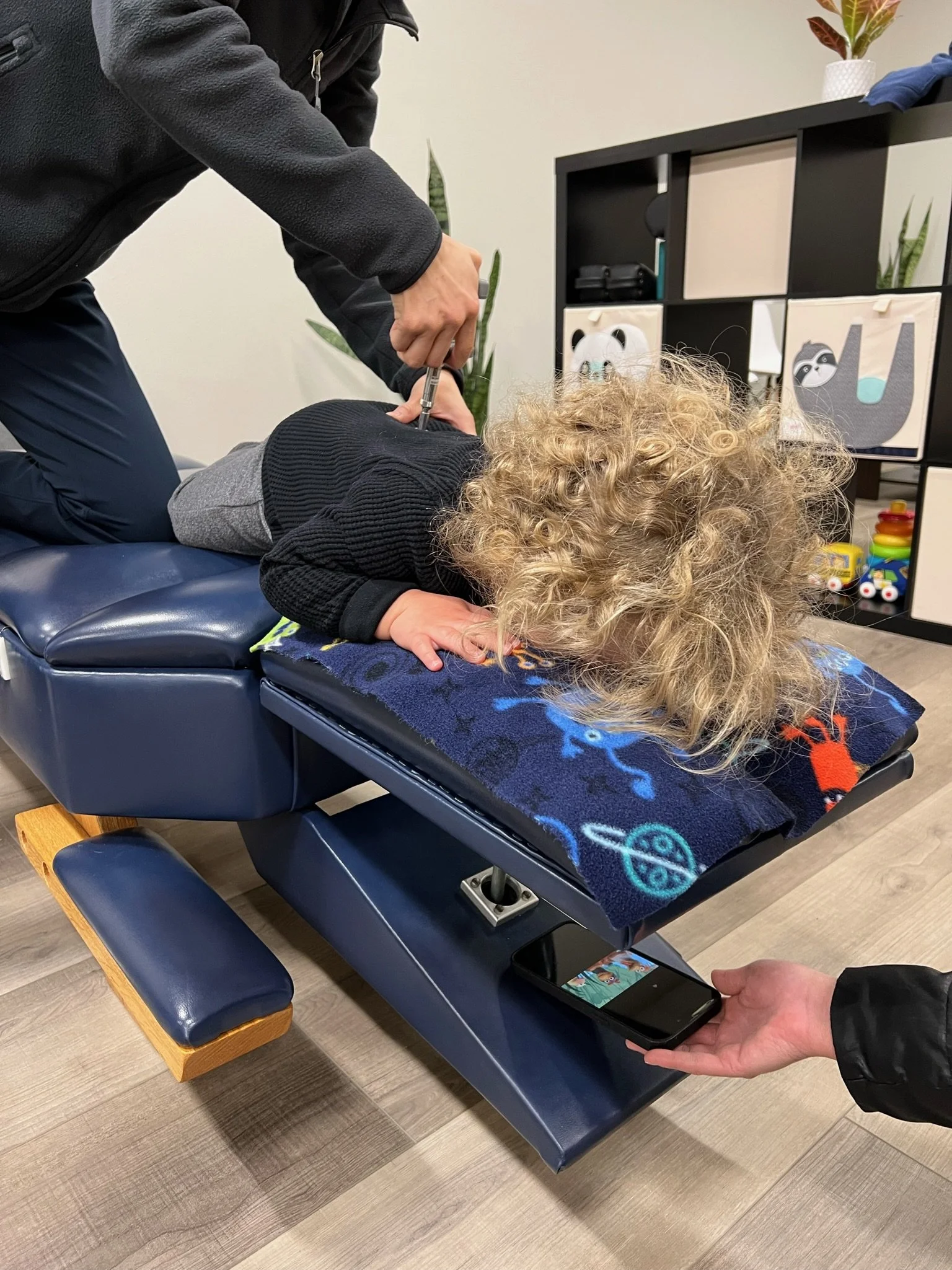
We help the nervous system shift into rest mode. We use Sacro-Occipital Technique (SOT), cranial work, and gentle instrument-assisted adjustments, always at your child's pace. A body that feels safe has an easier time relaxing and letting go.
We pay attention to the gut. Many families who come to us for constipation notice improvements in bowel movements and digestion during care, which can take a big barrier out of the way.
We add low-level laser therapy when it fits, using the Erchonia XLR8 and GVL lasers, 5 to 10 minutes a session, to support mitochondrial health and the body's natural healing.
What care looks like
Lasting change in the nervous system comes from consistent care over time, not a single visit, and every plan is built around your child. Learn more about how we care for neurodivergent kids.
One San Diego family's story
One family brought in their 3-year-old daughter for chronic constipation. Potty training wasn't even the goal yet. They just wanted her belly to feel better.
Over her first three months of care, her parents noticed her digestion and bowel movements improving. Then came a surprise. "We went on our first 'long' trip and realized she could hold it," her mom told us. "She was potty trained! Me and her dad were like, whoa!"
It's a good reminder of how connected these things are. When a child's belly feels better, the bathroom can stop feeling like something to avoid.
Every child is different, and results vary. We share stories like this with families' permission to show what progress can look like.
Frequently asked questions
At what age should an autistic child be potty trained? There's no single right age. Many autistic kids train later than their peers, and research shows many become dry during the day between ages 5 and 10. Readiness signs matter more than age.
Why will my child pee in the potty but not poop? This is very common, and constipation or a past painful poop is often behind it. Talk with your pediatrician about keeping stools soft, and keep the process low-pressure.
Should I use pull-ups? Many families use them at night or for outings. During the day, some kids learn faster in underwear because they can feel when they're wet. Your child's therapist can help you decide.
Can a pediatric chiropractor help with potty training? We don't potty train children. We focus on the nervous system and digestion, which play a big role in a child's ability to sense, relax, and go. Many families notice easier bowel movements during care, but every child is different.
My child is scared of the toilet. What do I do? Start small: sit fully clothed, flush after they leave the room, and try a potty chair instead of the big toilet. Fear makes the body tense up, so building safety comes first.
Your next step
If potty training has stalled and you suspect something deeper is going on, we'd love to help you look at the foundation underneath.
Your Initial Visit includes a gentle exam and INSiGHT nervous system scans, followed by a second visit to review results and talk through a plan. See what to expect at your child’s first visit.
We're located at 8799 Balboa Ave in Kearny Mesa, San Diego. We accept HSA and FSA cards. Have questions first? Call us at (619) 786-4886.
Proudly supporting kids with Autism across Clairemont, Mira Mesa, Scripps Ranch, Kearny Mesa, La Jolla, and all of San Diego
Sprout Family Chiropractic | Pediatric + Nervous System Experts
Disclaimer: This article is for educational purposes and is not intended as medical advice. Always consult your child’s healthcare provider for personalized guidance.